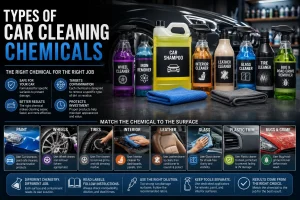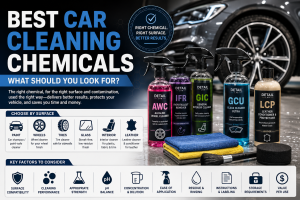

What is a Car Cleaning Chemicals Guide, and how do you choose the right ones? Car Cleaning Chemicals Guide are products formulated to remove specific types of contamination, dirt, brake dust, road grime, oils, and stains from specific vehicle surfaces such as paint, wheels, glass, and interior trim. Unlike a single all-purpose household cleaner, automotive cleaning chemicals are built around surface compatibility: what works safely on a wheel is rarely the right choice for leather, and what removes bugs from a bumper is not the same product you’d use on a windshield.
Automotive cleaning generally breaks down into a handful of categories:
- Exterior cleaning — paint, bodywork, and pre-wash contamination
- Wheels and tires — brake dust, iron particles, tire grime
- Interior cleaning — dashboards, plastics, fabric, and leather
- Glass cleaning — streak-free visibility inside and out
- Decontamination — bugs, road grime, iron fallout
- Protection — plastics, trim, and leather conditioning
There’s no single product that qualifies as the “best car cleaning chemical” for every job. The right choice always depends on the surface you’re cleaning, the type of contamination involved, how the product is formulated, and how it’s meant to be diluted and applied. This guide walks through the main categories of car cleaning chemicals, how they differ, and how to match the right chemical to the right task and where relevant, you can explore specific formulations in DetailLab’s Cleaning Chemicals range.
What Are Car Cleaning Chemicals?
Car cleaning chemicals are liquid, gel, or foam formulations designed to break down and lift contamination from vehicle surfaces without damaging the material underneath. That last part is the key difference from a generic household cleaner.
A kitchen degreaser, for example, is built to cut through cooking grease on hard, sealed countertops. It isn’t formulated with automotive coatings, clear-coat paint, vinyl, or leather in mind, so using it on a car can lead to dulling, discoloration, or premature wear. Automotive cleaning products are developed with those surfaces specifically in mind accounting for things like paint clear coats, anodized or coated wheel finishes, interior plastics, and natural or synthetic leather.
This is why surface compatibility matters so much in car care. A chemical that’s excellent at removing iron particles from a wheel might be entirely inappropriate for a dashboard. A leather cleaner formulated for seats isn’t designed for glass. Later sections of this guide, along with dedicated articles in this series, go deeper into each category; this section is just the foundation.
Types of Car Cleaning Chemicals
Automotive cleaning chemicals generally fall into these categories:
| Chemical Type | Main Purpose | Typical Application |
| Car shampoo | Routine washing | Exterior paint |
| Wheel cleaner | Wheel contamination | Wheels |
| Tire cleaner | Tire grime | Tires |
| Iron remover | Iron contamination | Wheels/paint |
| Interior cleaner | Interior dirt | Interior surfaces |
| Leather cleaner | Leather cleaning | Leather |
| Glass cleaner | Glass contamination | Windows |
| Multi-surface cleaner | General cleaning | Suitable surfaces |
| Bug remover | Insect residue | Exterior |
| Road-grime remover | Heavy road contamination | Exterior |
| Plastic cleaner/protectant | Plastic/trim care | Exterior/interior |
Not every chemical in this table should be used on every surface, even within the same vehicle. A cleaner built for tires, for instance, is usually far too aggressive for painted panels, and a glass cleaner isn’t formulated to lift embedded brake dust from a wheel. Reading the product label and matching the chemical to its intended surface is one of the simplest ways to avoid damage and get better cleaning results.
How to Choose the Best Car Cleaning Chemicals
“Best” is relative. A product that performs well for one driver’s needs might be the wrong pick for another. Here’s what actually determines whether a chemical is the right one for the job.
1. Surface Type
Paint, wheels, tires, glass, leather, plastic, and fabric all respond differently to chemical formulations. A product’s label should indicate which surfaces it’s designed for and that guidance should be followed rather than assumed.
2. Type of Contamination
Dust, grease, brake dust, iron particles, insect residue, road film, and stains all require different cleaning approaches. Heavier or bonded contamination (like baked-on bug residue or embedded iron particles) often calls for a targeted product rather than a general-purpose one.
3. Chemical Strength
Stronger doesn’t automatically mean better. A highly concentrated or aggressive formulation can clean faster, but it also raises the risk of surface damage, discoloration, or residue if it isn’t suited to the material or isn’t diluted correctly. Matching strength to the job, not just reaching for the most powerful product available, tends to produce better long-term results.
4. pH
Car cleaning chemicals are generally described as acidic, neutral, or alkaline. Each has different strengths and different considerations for surface safety, which is covered in more detail later in this guide.
5. Product Concentration and Dilution
Many professional and hand-car-wash chemicals are sold as concentrates meant to be diluted before use. Following the manufacturer’s recommended dilution ratio matters, using a product too strong can risk surface damage or streaking, while diluting it too much can leave contamination behind.
6. Application Method
Some chemicals are designed to be sprayed and agitated, others foamed through a cannon, others wiped directly with a microfiber towel. The intended method affects both performance and safety, so it’s worth checking before use.
7. Surface Compatibility
Before using any new chemical, especially on a coated, wrapped, or unfamiliar surface, it’s worth verifying compatibility either through the product’s instructions or by testing in a small, inconspicuous area first.
Car Cleaning Chemicals by Vehicle Surface
Paint
Paintwork typically involves several chemical categories working together: car shampoo for routine washing, pre-wash cleaners to loosen surface dirt before contact washing, bug removers for insect residue, iron removers for embedded metallic particles, and paint-safe multi-surface cleaners for spot cleaning. Because clear coat is relatively easy to mar or dull, paint-safe formulations are generally gentler than wheel or tire chemicals.
Wheels
Wheels accumulate some of the toughest contamination on a vehicle brake dust, embedded iron particles, and baked-on road grime. Wheel cleaning chemicals range from acidic formulas built for heavy contamination to non-acid (typically alkaline or neutral) formulas designed to be gentler on coated and factory-finished wheels. Iron removers and dedicated brake-dust cleaners often work alongside general wheel cleaners rather than replacing them.
Tires
Tire cleaners are formulated to cut through the grease, oils, and road grime that build up on rubber, and are usually followed by a tire dressing to restore appearance and provide some protection. Because tire compounds can tolerate more aggressive chemistry than paint or wheels, tire-specific degreasers are common but they should stay off adjacent painted or wheel surfaces where possible.
Glass
Automotive glass cleaners are formulated to cut through the specific film that builds up on windshields and windows a mix of road film, interior off-gassing, and fingerprints while evaporating quickly enough to avoid streaking. Interior and exterior glass sometimes call for slightly different approaches, since interior glass deals more with skin oils and haze while exterior glass deals more with weather and road contamination.
Leather
Leather cleaners are designed to lift dirt and body oils from seating surfaces without stripping or drying the material. Leather conditioners and protectants are typically used afterward to help maintain flexibility and appearance over time. Because leather varies (natural, coated, synthetic), checking product compatibility with your specific seating material is worthwhile.
Plastic & Trim
Interior plastic cleaners target dashboards, door panels, and trim without leaving a greasy or overly glossy residue, while exterior plastic and trim products often include UV protection to slow fading. Plastic protectants can be finished in satin or gloss depending on preference.
Fabric & Carpet
Fabric cleaners and carpet cleaners are formulated to lift ground-in dirt and staining from cabin textiles. Dedicated stain-removal products are sometimes used for spot treatment before a broader fabric or carpet cleaning pass.
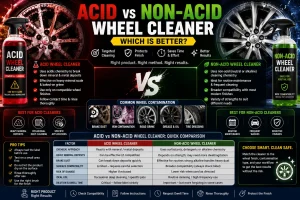
Wheel Cleaning Chemicals: Acid vs Non-Acid
Wheel cleaning is one of the most commonly searched and most commercially important categories in automotive care, largely because wheels face some of the harshest contamination on a vehicle and because wheel finishes vary so widely between factory coatings, aftermarket finishes, and bare metal.
Acid Wheel Cleaners
Acid-based wheel cleaners are formulated to react aggressively with embedded contamination such as heavy brake dust and baked-on grime. They’re often chosen where contamination is severe and a faster, stronger reaction is needed. Because of their strength, surface compatibility is especially important acid formulas are not universally suited to every wheel finish, and manufacturer guidance should always be checked before use, particularly on delicate, coated, or aftermarket wheels.
Non-Acid Wheel Cleaners
Non-acid wheel cleaners are usually alkaline or pH-neutral formulations built to clean effectively while being gentler on a broader range of wheel finishes, including many factory-coated wheels. DetailLab’s AWC alkaline wheel cleaner is one example of this category, positioned for fast cleaning on factory-coated wheels. Non-acid formulas can require a bit more dwell time or agitation on very heavy contamination compared to acid formulas, but they generally offer a wider margin of safety across different wheel types.
| Feature | Acid Wheel Cleaner | Non-Acid Wheel Cleaner |
| Cleaning strength | Fast-acting on heavy, bonded contamination | Effective on routine to moderate contamination |
| Typical use | Severe brake dust or grime buildup | Regular maintenance washes and coated wheels |
| Surface considerations | Requires careful compatibility checks, especially on coated or aftermarket finishes | Generally broader compatibility, but always confirm with product instructions |
| Heavy contamination | Often faster on stubborn buildup | May need extra dwell time or agitation |
| Ease of use | Requires close attention to dilution and contact time | Typically more forgiving to use |
| Safety considerations | Handle with appropriate care and ventilation; avoid contact with skin and eyes | Still requires standard chemical safety precautions |
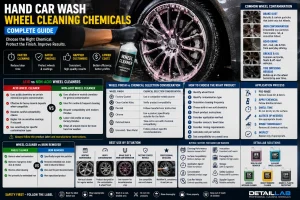
For hand car wash operations, choosing between an acid and non-acid wheel cleaning chemical often comes down to the mix of vehicles serviced. A business cleaning a high volume of factory-finished wheels may lean toward a non-acid formula for everyday use, while reserving stronger acid-based products for occasional deep-cleaning jobs where contamination is more severe.
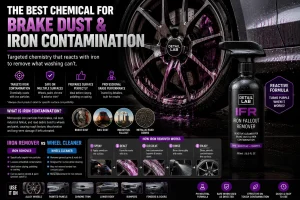
Brake Dust and Iron Contamination
Brake dust is made up of fine particles released from brake pads and rotors during normal driving, and it tends to bond to wheels and, over time, to lower body panels. Iron contamination refers more broadly to tiny metallic particles often from brake components or environmental sources like rail dust that embed into paint and wheel surfaces.
Regular washing with car shampoo or a general wheel cleaner can remove surface-level dirt, but it often isn’t enough to lift particles that have bonded chemically to the surface. That’s where iron-reactive cleaners come in: these products are formulated to react with embedded iron particles, typically producing a visible color change that signals the contamination is being broken down and lifted.
Wheel Cleaner vs Iron Remover
A general wheel cleaner is built to handle everyday dirt, brake dust residue, and road grime on the wheel surface. An iron remover is a more targeted product aimed specifically at embedded metallic contamination that a standard wheel cleaner may not fully address. Many detailers use both a wheel cleaner for routine washing and an iron remover periodically for deeper decontamination. DetailLab’s IFR iron fallout remover is an example of a reactive cleaner built for this purpose. As always, following the product’s instructions for contact time and rinsing is important for both effectiveness and surface safety.
Interior Car Cleaning Chemicals
Interior cleaning covers more surface variety than any other part of the vehicle — hard plastics, soft-touch materials, leather, fabric, carpet, and glass all sit within arm’s reach of each other, and each responds differently to chemicals.
- General interior cleaners handle everyday dust, fingerprints, and light soiling across plastic and vinyl surfaces.
- Leather cleaners are formulated to lift dirt and oils from leather without stripping its finish.
- Fabric cleaners target cloth seating and upholstery.
- Carpet cleaners are built for ground-in dirt on flooring and mats.
- Plastic cleaners address dashboards, door cards, and trim.
- Glass cleaners handle interior windshield and window film.
| Interior Surface | Suitable Chemical Category |
| Dashboard | Interior/plastic cleaner |
| Plastic trim | Interior/plastic cleaner |
| Leather seats | Leather cleaner |
| Fabric seats | Fabric cleaner |
| Carpets | Carpet cleaner |
| Door panels | Interior/plastic cleaner |
| Interior glass | Glass cleaner |
Because interior materials sit so close together, it’s easy to assume one product can handle all of them. In practice, using a dedicated cleaner for leather, and a separate one for fabric or hard plastic, tends to give more consistent, surface-appropriate results. DetailLab’s GIC general interior cleaner is built for routine cabin maintenance across interior surfaces, while dedicated leather products handle seating separately.
Glass Cleaning Chemicals
Automotive glass needs a cleaner suited to the specific film that builds up on windshields and windows a combination of road grime, interior off-gassing, smoke residue, and fingerprints that ordinary glass cleaners aren’t always formulated to handle cleanly on tinted or coated automotive glass.
Exterior glass generally deals with more weather-related and road contamination, while interior glass tends to collect skin oils and a light haze from cabin materials. A fast-evaporating formula, like DetailLab’s GCU glass cleaner, helps reduce the risk of streaking, since glass cleaners that sit too long before wiping can leave residue behind. Pairing the right chemical with a clean, dedicated microfiber towel — rather than one used elsewhere on the vehicle — also makes a noticeable difference in the final result.
Multi-Surface Car Cleaning Chemicals
Multi-surface cleaners are formulated to work across a range of interior and, in some cases, exterior materials, making them useful for quick spot cleaning and general maintenance without switching between several dedicated products. DetailLab’s DC multi-surface detail cleaner is an example built for stains and everyday detailing tasks.
The advantage is convenience one product that can handle plastic, some fabric, and general spot-cleaning needs. The trade-off is that a multi-surface product is rarely as targeted as a dedicated leather cleaner, glass cleaner, or wheel cleaner for that specific material. “Multi-purpose” doesn’t mean “safe for every surface” it’s still worth checking the label before applying it to leather, glass, or anything with a specific coating, since dedicated products often remain the better choice for those surfaces.
Bug and Road-Grime Cleaning Chemicals
Insect residue and road grime are two of the more stubborn forms of exterior contamination, and both tend to get harder to remove the longer they sit. Insect residue is often slightly acidic and can etch into clear coat if left for extended periods, especially in hot weather. Road grime a mix of oils, tar, and particulate builds up mainly on lower panels, bumpers, and rocker areas.
Dedicated bug and road-grime removers are typically applied as part of a pre-wash step, allowed to dwell briefly, and then rinsed or gently agitated rather than scrubbed. Aggressive scrubbing on bonded residue increases the risk of marring the paint, so a chemical that loosens contamination first like DetailLab’s IRC insect remover cleaner reduces how much physical agitation is needed. Removing this type of contamination promptly, rather than letting it accumulate over multiple drives, generally makes the full exterior wash faster and gentler on the paint.
Professional Car Cleaning Chemicals
Professional detailers, mobile detailing businesses, car washes, dealerships, and workshops evaluate chemicals with a broader set of priorities than an occasional DIY wash. Common considerations include:
- Cleaning performance across a wide range of vehicle conditions
- Consistency from one bottle or batch to the next
- Dilution flexibility to adjust strength for different jobs
- Application speed, since time often drives profitability
- Surface compatibility across many different makes, models, and finishes
- Cost per use, especially for concentrated products
- Workflow fit, so chemicals integrate smoothly into a wash-bay or mobile setup
- Storage requirements, particularly for businesses handling larger volumes
It’s a common assumption that “professional” chemicals are automatically stronger or more effective than consumer products but that isn’t necessarily the case. Professional-oriented products are often selected more for consistency, dilution economics, and workflow efficiency than for raw strength.
Car Cleaning Chemicals for Hand Car Washes
Hand car wash businesses typically organize their chemical lineup around the actual flow of a vehicle through the wash process, rather than by product type alone. A practical lineup usually includes:
- Pre-wash cleaner (loosens surface dirt before contact)
- Car shampoo (main exterior wash step)
- Wheel cleaner (dedicated wheel step, separate from body panels)
- Tire cleaner (paired with tire dressing)
- Interior cleaner (cabin and trim maintenance)
- Glass cleaner (interior and exterior windows)
- Multi-surface cleaner (spot cleaning and stains)
- Bug/road-grime remover (pre-wash decontamination)
- Protection products (plastic, leather, or trim finishing)
Organizing hand car wash chemicals by workflow step pre-wash, wheels, body, interior, glass, finish rather than by shelf space alone tends to reduce cross-contamination between products (like wheel cleaner residue ending up on a wash mitt meant for paint) and speeds up staff training, since each station has a clear, consistent product assignment.
Car Cleaning Chemical Manufacturers
When evaluating a car cleaning chemical manufacturer or brand, buyers whether individual detailers or businesses typically look at a similar set of factors:
- Product consistency from batch to batch
- Clear instructions for dilution, application, and dwell time
- Surface compatibility information provided on labels or documentation
- Technical documentation such as safety data sheets
- Quality control practices
- Product range covering the surfaces and tasks actually needed
- Packaging suited to the intended use (retail bottle vs. bulk concentrate)
- Labeling that’s clear and accurate
- Customer support for questions about use or compatibility
- Professional/commercial requirements, such as bulk sizing or distributor support
DetailLab positions itself around what it describes as “smarter cleaning logic” and a focused product range for car cleaning and maintenance, offering a lineup that spans wheels, leather, glass, interior surfaces, and multi-surface cleaning. If you’re evaluating chemicals for a business or a growing detailing practice, it’s worth checking a brand’s product documentation and instructions directly, since specific claims about formulation or manufacturing should always come from verified product information rather than assumption.
Understanding pH in Car Cleaning Chemicals
pH is a simple way to describe how acidic, neutral, or alkaline a cleaning chemical is. In automotive cleaning, it’s a useful shorthand for anticipating how a product might interact with a given surface.
| pH Type | General Characteristics | Common Considerations |
| Acidic cleaners | Effective on tough, bonded contamination (e.g., some wheel cleaners) | Often require closer attention to surface compatibility and contact time |
| Neutral cleaners | Gentler, broadly compatible formulations | May need more dwell time or agitation on heavy contamination |
| Alkaline cleaners | Effective on grease, oils, and organic residue | Can affect certain finishes if not diluted or used as directed |
Stronger chemistry whether more acidic or more alkaline isn’t automatically “better.” It generally means faster action on tough contamination, paired with a narrower margin for error on surface compatibility. Following the manufacturer’s instructions for dilution, contact time, and rinsing is the most reliable way to get good results regardless of where a product sits on the pH scale.
What Makes a Car Cleaning Chemical “The Best”?
Rather than ranking specific products without evidence, it’s more useful to define what “best” actually means in context. A well-suited car cleaning chemical is generally one that is:
- Appropriate for the specific surface it’s being used on
- Suitable for the type of contamination present
- Effective at its intended dilution ratio
- Straightforward to apply with standard detailing equipment
- Clearly labeled with usage instructions
- Backed by proper application and safety guidance
- Compatible with the vehicle’s specific materials and finishes
- A good fit for the user’s actual workflow, whether that’s a weekend wash or a full-time detailing operation
Under this definition, the “best” wheel cleaner for a factory-coated wheel might be a gentle non-acid formula, while the “best” wheel cleaner for heavily neglected, contaminated wheels at a used-car reconditioning shop might be a stronger acid-based product. Both can be correct, depending on the situation.
Car Cleaning Chemicals vs Household Cleaning Products
It’s tempting to reach for a household all-purpose cleaner or glass spray already under the sink, but automotive-specific products are generally the safer choice for vehicles, for a few reasons:
- Surface compatibility — automotive formulations account for clear coat, coated wheels, vinyl, and leather in ways household products typically don’t.
- Formulation — many household cleaners are built for hard, sealed surfaces like tile or countertops rather than the more varied, sensitive materials found in a car.
- Application — automotive products are designed to be used with detailing tools and techniques (foam cannons, microfiber towels, specific dwell times).
- Residue — some household cleaners can leave streaking, filming, or discoloration on automotive surfaces they weren’t designed for.
- Interior considerations — cabin materials like leather and certain plastics can be more sensitive to harsh detergents than kitchen or bathroom surfaces.
This isn’t to say household cleaners are inherently harmful many are perfectly safe in their intended setting. The point is that automotive cleaning chemicals are formulated with a vehicle’s specific surfaces in mind, which generally makes them a more predictable and appropriate choice for car care.
How to Use Car Cleaning Chemicals Safely
- Read the product’s instructions before first use
- Follow the recommended dilution ratio rather than guessing
- Test on a small, inconspicuous area when trying a new product or surface
- Use appropriate protective equipment, such as gloves and eye protection, where recommended
- Ensure adequate ventilation, especially with interior or enclosed-space cleaning
- Avoid combining different chemicals unless the manufacturer specifically states it’s safe
- Store chemicals in their original, labeled containers
- Keep all products clearly labeled, especially if decanted into secondary bottles
- Keep chemicals out of reach of children and pets
- Follow the manufacturer’s specific storage recommendations (temperature, light exposure, etc.)
Common Car Cleaning Chemical Mistakes
Using the wrong chemical on a surface. Solution: check the label for intended surfaces before applying, and keep wheel, glass, leather, and multi-surface products clearly separated.
Using too much product. Solution: apply only what’s needed for the surface area more product doesn’t necessarily mean better cleaning, and can increase the risk of residue.
Ignoring dilution instructions. Solution: measure dilution ratios rather than estimating, particularly with concentrated professional products.
Choosing products only by strength. Solution: match the chemical to the contamination and surface first, and consider strength secondary to compatibility.
Leaving chemicals on surfaces too long. Solution: follow recommended dwell times, especially for wheel cleaners and iron removers, and don’t let products dry on the surface.
Using one chemical for everything. Solution: build a small, purpose-specific kit rather than relying on a single multi-surface product for every task.
Mixing different chemicals. Solution: never combine cleaning chemicals unless a manufacturer explicitly confirms it’s safe to do so.
Poor storage. Solution: store products in their original containers, away from direct sunlight and temperature extremes, following label guidance.
Not testing compatibility. Solution: test new products on a small, hidden area before full application, particularly on wraps, coatings, or aftermarket finishes.
How to Build a Complete Car Cleaning Chemical Collection
Beginner
Essential products for routine vehicle cleaning: car shampoo, a wheel cleaner, an interior cleaner, and a glass cleaner cover most regular maintenance needs.
Enthusiast
Building on the basics with decontamination and more specialized products: iron remover, bug/road-grime remover, and a dedicated leather cleaner for more thorough, periodic detailing.
Professional
A broader chemical system built around the specific services offered which may include multiple wheel cleaner strengths, dedicated fabric and carpet cleaners, plastic and trim protectants, and bulk or concentrate options suited to higher-volume workflows.
| Category | Beginner | Enthusiast | Professional |
| Car shampoo | ✓ | ✓ | ✓ |
| Wheel cleaner | ✓ | ✓ | ✓ |
| Interior cleaner | ✓ | ✓ | ✓ |
| Glass cleaner | ✓ | ✓ | ✓ |
| Iron remover | Optional | ✓ | ✓ |
| Bug remover | Optional | ✓ | ✓ |
| Leather cleaner | Optional | ✓ | ✓ |
| Specialized chemicals | ✓ |
Car Cleaning Chemical Selection Guide
A quick reference for matching the task to the chemical category:
- Paint → Car shampoo / paint-safe cleaner
- Wheels → Wheel cleaner
- Brake dust / iron → Iron remover
- Tires → Tire cleaner
- Glass → Glass cleaner
- Leather → Leather cleaner
- Fabric → Fabric cleaner
- Plastic → Suitable plastic/interior cleaner
- Bugs → Bug remover
- Road grime → Appropriate exterior cleaner
Frequently Asked Questions
1. What are car cleaning chemicals?
Car cleaning chemicals are products formulated to remove specific types of contamination from specific vehicle surfaces, such as wheel cleaners, glass cleaners, leather cleaners, and car shampoo.
2. What are the best car cleaning chemicals?
There’s no single “best” product for every situation the right chemical depends on the surface being cleaned, the type of contamination, and the manufacturer’s instructions for dilution and application.
3. What chemicals are used for car cleaning?
Common categories include car shampoo, wheel cleaner, tire cleaner, iron remover, interior cleaner, leather cleaner, glass cleaner, multi-surface cleaner, and bug/road-grime remover.
4. What chemicals do professional detailers use?
Professionals often use a wider, more specialized range of chemicals selected for consistency, dilution flexibility, and workflow efficiency, spanning wheel, paint, interior, and glass care.
5. What is the best chemical for cleaning car wheels?
Wheel cleaners range from acid-based formulas for heavy contamination to non-acid (alkaline or neutral) formulas for gentler, everyday use on coated wheels the right choice depends on the wheel finish and contamination level.
6. Are acid wheel cleaners safe for cars?
Acid wheel cleaners can be effective on heavy contamination, but surface compatibility varies by wheel finish, so it’s important to check manufacturer guidance before use, especially on coated or aftermarket wheels.
7. What is the difference between acid and non-acid wheel cleaners?
Acid wheel cleaners tend to act faster on heavy, bonded contamination, while non-acid formulas are generally gentler and offer broader compatibility across wheel finishes.
8. What chemical removes brake dust?
General wheel cleaners handle everyday brake dust residue, while dedicated iron removers target embedded metallic particles that regular washing may not fully remove.
9. What chemicals are used for interior car detailing?
Interior detailing typically involves a general interior cleaner, a leather cleaner for seating, a fabric or carpet cleaner for textiles, and a glass cleaner for windows.
10. What is the best car cleaning chemical for leather?
Leather cleaners are formulated to lift dirt and oils without stripping the material’s finish, often paired with a leather conditioner or protectant for ongoing care.
11. What chemical is best for car glass?
A dedicated automotive glass cleaner, formulated to cut through road film and interior haze while evaporating quickly, helps reduce streaking on both interior and exterior glass.
12. What are professional car wash chemicals?
These are chemicals selected by car washes and detailing businesses for consistency, dilution economics, and workflow speed across high vehicle volumes, rather than for raw strength alone.
13. How do I choose automotive cleaning chemicals?
Consider the surface type, the contamination present, the chemical’s pH and strength, the recommended dilution, and the application method before selecting a product.
14. What does pH mean in car cleaning chemicals?
pH indicates whether a chemical is acidic, neutral, or alkaline, which affects how it interacts with different surfaces and how carefully it needs to be used.
15. Can I use household cleaning products on my car?
Household cleaners aren’t generally formulated for automotive surfaces like clear coat, coated wheels, or leather, so automotive-specific products are typically the safer and more predictable choice.
Conclusion
There’s no single chemical that works best for every surface on a vehicle. Wheels, paint, glass, leather, and interior trim each call for their own approach, based on the type of contamination involved and the material being cleaned. Choosing the right product means looking at the surface first, the contamination second, and matching chemical strength and pH accordingly, always guided by the manufacturer’s instructions for dilution, dwell time, and application.
For professional detailers, mobile businesses, and hand car washes, the same principles apply at a larger scale, with added weight given to consistency, dilution economics, and workflow efficiency. Building a chemical collection step by step starting with the basics and adding specialized products as needed tends to produce better, safer results than reaching for one product to handle everything.
If you’re building out your own lineup of car cleaning chemicals, DetailLab’s Cleaning Chemicals range covers wheels, leather, glass, interior surfaces, and multi-surface cleaning, and is worth a look as a starting point for matching the right chemical to your specific cleaning needs.