

Is an acid or non-acid wheel cleaner better? Neither one wins outright. The right wheel cleaning chemical depends on the wheel material, the wheel finish, the type and severity of contamination, how often the wheels are cleaned, the specific product formulation, and the application method the manufacturer recommends. Modern wheel-cleaning products draw on several different chemical approaches acidic, alkaline, and iron-reactive and each one is built to solve a slightly different problem.
This guide breaks down how acid wheel cleaner and non-acid wheel cleaner formulas actually differ, what each is generally used for, how brake dust and other contamination change the equation, and how car owners, DIY detailers, mobile detailers, professional shops, and hand car washes can make a more informed choice.
What Is an Acid Wheel Cleaner?
An acid-based wheel cleaner relies on acidic chemistry to break down contamination on a wheel’s surface. This category is sometimes referred to as acid-based wheel cleaner or acidic wheel cleaner, and the chemistry behind it is generally selected because acids can react effectively with certain mineral and metal-based deposits the kind of buildup that plain water and soap struggle to shift.
This reactivity is exactly why acidic formulas can be effective against specific types of heavy contamination, such as long-neglected mineral scale or deeply baked-on grime. It’s also why they require careful surface selection. Not every wheel finish can tolerate acidic chemistry, and a product that performs well on one type of wheel can cause discoloration, etching, or corrosion on another.
Contact time matters just as much as the chemistry itself. An acid wheel cleaner that is left on too long, allowed to dry, or applied outside the manufacturer’s instructions is far more likely to cause damage than one that is applied, agitated, and rinsed within the recommended window. For this reason, acid-based products can be genuinely useful in the right application, but they are not a “set and forget” solution they demand attention to detail every time they’re used. This article won’t walk through mixing ratios or DIY acid formulations; that’s a job for the product label and the manufacturer’s documentation, not a blog post.
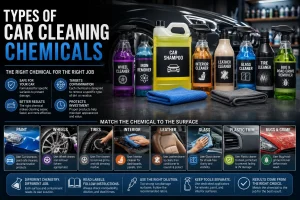
For a complete overview of vehicle cleaning products, methods, and best practices, explore our Car Cleaning Chemicals Guide. It covers the different types of car cleaning chemicals, their uses, application methods, and tips for choosing the right products for exterior and interior detailing. Whether you are maintaining a personal vehicle or running a professional car wash, this guide can help you select and use cleaning chemicals more effectively.
What Is a Non-Acid Wheel Cleaner?
A non-acid wheel cleaner is any wheel cleaning product that doesn’t rely on acidic chemistry to do its work. That’s an important but frequently misunderstood point: non-acid does not automatically mean pH-neutral, and it doesn’t automatically mean weak.
Some non-acid formulas sit close to neutral pH and are built for gentle, frequent use. Others are alkaline wheel cleaner formulations that can be just as aggressive in a different direction as an acidic product. Industry product comparisons make this clear: non-acid wheel cleaning chemistry can vary significantly from one product to the next, ranging from mildly alkaline to strongly alkaline, with correspondingly different levels of cleaning power and surface risk.
Broadly, non-acid products fall into a few buckets:
- pH-neutral cleaners — formulated to sit close to neutral, generally positioned for frequent use on a wide range of finishes.
- Mildly alkaline cleaners — still non-acid, but with more cleaning power for routine-to-moderate contamination.
- Stronger alkaline cleaners — capable of tackling heavier brake dust and grime, but still requiring attention to dilution and dwell time.
What actually loosens the dirt in a non-acid formula is usually a combination of surfactants, detergents, and other cleaning agents that lift road film, oils, and dust off the wheel surface so it can be rinsed away rather than a direct chemical reaction with mineral deposits the way an acid does.
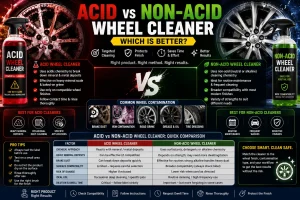
Acid vs Non-Acid Wheel Cleaner: Quick Comparison
| Factor | Acid Wheel Cleaner | Non-Acid Wheel Cleaner |
| Chemical approach | Reacts with mineral/metal-based deposits | Uses surfactants, detergents, or alkaline chemistry to lift contamination |
| Heavy mineral deposits | Can be effective when the product and finish are compatible | Depends on formulation strength; may need more agitation or dwell time |
| Brake dust | Can break down certain deposits quickly | Effective for routine buildup; stronger alkaline versions handle heavier dust |
| Road grime | Generally effective | Generally effective |
| Routine maintenance | Often more aggressive than routine use requires | Frequently better suited to regular washing |
| Surface sensitivity | Higher risk on sensitive or bare finishes | Risk varies with alkalinity; not automatically low-risk |
| Wheel-finish considerations | Requires confirmed compatibility before use | Still requires compatibility checks, especially for stronger formulas |
| Application requirements | Strict attention to dilution and contact time | Application still governed by label instructions |
| Safety considerations | PPE, ventilation, and careful handling required | PPE and label instructions still apply |
| Best use case | Specific heavy or difficult contamination on compatible finishes | Routine cleaning and a wide range of everyday wheel-cleaning chemicals |
Neither column is the “winner” here the table is meant to show where each approach tends to fit, not to declare one type universally superior.
What Contaminants Are Found on Wheels?
Understanding what’s actually on the wheel is the starting point for choosing between an acid wheel cleaner and a non-acid option.
Brake Dust
Brake dust forms as brake pads and rotors wear, and it commonly contains iron-rich particles along with other material shed from the braking system. It tends to bake onto the wheel surface with heat cycles, which is part of why it can be stubborn to remove with an ordinary wash.
Iron Contamination
Some of the material in brake dust and airborne fallout more broadly is embedded iron. This type of contamination often benefits from specialized iron-reactive chemistry rather than general-purpose wheel cleaning chemicals, because the goal is to chemically break down the particle rather than simply lift surface grime.
Road Grime
This category covers dirt, oils, road film, mud, and general environmental buildup. It’s usually the easiest contamination to remove and often responds well to routine cleaning products.
Mineral Deposits
Hard water and mineral buildup can leave a chalky or etched-looking residue on wheels, particularly in areas with hard water or where wheels sit uncleaned for long periods.
Tire Dressing Residue
Overspray and buildup from tire dressings can accumulate around the wheel barrel and lip, adding another layer of contamination that isn’t always addressed by a standard wash.
Different contaminants respond differently to different cleaning chemistries which is exactly why “acid vs non-acid” isn’t a one-size-fits-all question.
Acid Wheel Cleaner for Heavy Contamination
Acidic chemistry can sometimes be the more practical choice for severe mineral deposits, certain types of heavy wheel contamination, neglected wheels that haven’t been cleaned in a long time, or specific professional cleaning situations where a job calls for stronger chemistry.
That said, acid is not automatically the best solution just because contamination is heavy. Before reaching for an acid-based product:
- Confirm the wheel finish is actually compatible with the product.
- Follow the manufacturer’s dilution and application instructions exactly.
- Respect the recommended contact or dwell time longer is not better.
- Never allow the product to dry on the wheel unless the manufacturer explicitly says that’s acceptable.
- Use appropriate protective equipment for the person applying the product.
This article won’t specify acid concentrations or strengths those decisions belong to the product label, not a general guide.
Non-Acid Wheel Cleaner for Routine Maintenance
Non-acid formulas are frequently chosen for regular wheel washing, frequent maintenance schedules, modern factory-coated wheels, routine brake dust and road grime, and general professional detailing workflows where wheels are cleaned often rather than rescued from years of neglect.
Some non-acid products lean alkaline for extra cleaning power, while others sit closer to neutral for gentler, more frequent use. That range matters: it’s inaccurate to describe every non-acid product as equally mild, since a strongly alkaline non-acid cleaner can still require care around dilution, dwell time, and surface compatibility.
Acid vs Non-Acid for Brake Dust
Brake dust deserves its own section because it’s one of the most common reasons people go looking for a stronger wheel cleaning chemical in the first place.
Brake dust is generated as brake components wear, and it often bonds to the wheel surface through repeated heat cycles, making it more stubborn than surface dirt. Ordinary car shampoo, built for paint rather than wheels, usually isn’t formulated to break this down efficiently.
Acidic chemistry can attack certain mineral and metal-based deposits directly, which is part of why acid products have a reputation for cutting through brake dust quickly. But that’s not the only path to a clean wheel. Non-acid products including alkaline formulas approach the same contamination differently, using detergents and surfactants (and, in some cases, alkalinity) to loosen and lift the buildup rather than chemically dissolve it outright.
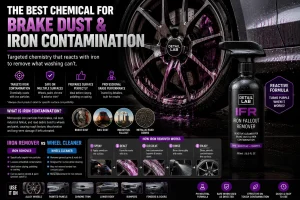
There’s also a third category worth knowing: iron removers. These are formulated around iron-reactive chemistry specifically designed to target embedded iron particles. Not every brake-dust problem requires acid an iron-reactive product can offer an effective alternative to more aggressive chemistry in suitable applications, particularly where iron contamination is the main concern rather than general grime.
Acid vs Non-Acid vs Iron Remover
| Product Type | Main Purpose | Typical Strength | Main Consideration |
| Acid wheel cleaner | Certain mineral/heavy deposits | Depends on formulation | Surface compatibility |
| Non-acid wheel cleaner | General wheel cleaning | Varies widely | Chemistry can range from mild to highly alkaline |
| Iron remover | Iron contamination | Specialized | Designed around iron-reactive chemistry |
“Iron remover” isn’t simply another name for a wheel cleaner it’s a distinct product category built around reacting specifically with iron particles, often used as a decontamination step on paint as well as wheels. Some products overlap in what they can address, but their intended chemistry and primary use case differ, so it’s worth checking what a product is actually designed to do rather than assuming based on the label alone.
Wheel Finish Compatibility
This is one of the most important factors in the entire acid-vs-non-acid decision, because the same chemical should never automatically be assumed safe across every wheel finish.
Factory-Coated Wheels
The factory coating provides a protective layer, but compatibility with a specific cleaning chemical should still be checked rather than assumed.
Clear-Coated Alloy Wheels
A clear coat changes how a wheel responds to aggressive chemistry, and products should be matched to that layer rather than treated the same as bare metal.
Painted Wheels
Product selection should follow the instructions provided for painted finishes specifically, since paint can respond differently than metal or clear coat.
Powder-Coated Wheels
Compatibility should be verified before applying any wheel cleaning chemical, as powder coating can be more sensitive to certain formulations than people expect.
Chrome Wheels
Strong chemistry acidic or highly alkaline can create risk for chrome plating, especially around edges, welds, or areas where the plating may already be compromised.
Polished Aluminum
Bare or polished aluminum can be particularly sensitive to aggressive chemistry, and extra caution is warranted, especially with acidic products.
Anodized Wheels
Anodized finishes may require specialized care and a cleaner specifically suited to that surface.
| Wheel Finish | General Chemical Consideration |
| Factory-coated | Use a compatible dedicated wheel cleaner |
| Clear-coated | Verify product compatibility |
| Painted | Follow manufacturer/product instructions |
| Powder-coated | Check compatibility before use |
| Chrome | Avoid unsuitable aggressive chemistry |
| Polished/bare aluminum | Extra caution with acidic chemistry |
| Anodized | Use only a compatible cleaner |
Current detailing guidance consistently comes back to the same principle: check the wheel material and finish before reaching for aggressive chemistry of any kind, acidic or alkaline.
When Should You Choose an Acid Wheel Cleaner?
An acid wheel cleaner may be appropriate when the product is specifically designed for the wheel finish in question, contamination is genuinely difficult to remove with gentler options, mineral deposits are present, the specific cleaning application calls for acidic chemistry, the person applying it understands the product instructions, and proper safety precautions can be followed from start to finish.
It’s worth repeating: “appropriate” does not mean “universally safe.” Even in situations where acid chemistry makes sense, it still requires care, correct dilution, and attention to the wheel finish.
When Should You Choose a Non-Acid Wheel Cleaner?
A non-acid option may be preferable when wheels are cleaned frequently, the finish is sensitive or its compatibility is uncertain, routine brake dust and road grime are the main concern rather than years of neglect, the goal is a versatile product that can handle a range of situations, or the manufacturer’s instructions specifically recommend a non-acid formula for that finish.
At the same time, non-acid does not automatically mean gentle. A strongly alkaline non-acid cleaner still needs to be matched to the wheel and used according to instructions.
How to Choose a Wheel Cleaning Chemical
- Identify the wheel finish — factory-coated, clear-coated, painted, powder-coated, chrome, polished aluminum, or anodized.
- Identify the contamination — brake dust, iron, road grime, mineral deposits, or tire dressing residue.
- Decide whether the cleaning is routine or heavy-duty — regular maintenance calls for a different approach than a neglected wheel.
- Check product chemistry — acidic, non-acid/alkaline, or iron-reactive.
- Check pH information where available — this helps clarify how aggressive a product actually is, acid or not.
- Verify surface compatibility — confirm the product is suited to your specific wheel finish.
- Check application instructions — spray method, dilution, and agitation requirements.
- Check contact/dwell instructions — and don’t exceed them.
- Consider rinsing requirements — some products need faster or more thorough rinsing than others.
- Consider cost per vehicle — concentration and dilution ratios affect real-world cost.
- Test compatibility where appropriate — an inconspicuous test area can catch a mismatch before it becomes a problem.
Safety Considerations When Using Wheel Cleaners
Regardless of whether a product is acidic or non-acid, a few safety habits apply across the board:
- Read the product label before every use.
- Follow the manufacturer’s instructions exactly, including dilution ratios.
- Wear appropriate PPE, such as gloves and eye protection.
- Avoid spraying yourself or others during application.
- Work in a suitable, ventilated environment.
- Avoid applying chemicals to excessively hot surfaces unless the product specifically allows it.
- Don’t allow products to dry on the surface unless explicitly instructed otherwise.
- Rinse according to the manufacturer’s instructions.
- Never mix cleaning chemicals together.
- Store products correctly and keep containers labeled.
- Keep all chemicals away from children and pets.
Common Mistakes When Using Acid Wheel Cleaners
- Using acid on an incompatible finish — always confirm compatibility first.
- Using too much product — follow the recommended amount rather than over-applying.
- Ignoring dilution instructions — dilute exactly as directed, not “by eye.”
- Leaving the product on too long — set a timer if needed and stick to the dwell time.
- Allowing the product to dry — rinse before this happens, especially in hot weather.
- Applying to excessively hot wheels — let wheels cool first unless the label says otherwise.
- Using acid when a less aggressive product would work — match the chemistry to the actual contamination.
- Not rinsing properly — rinse thoroughly and check for residue.
- Failing to use appropriate PPE — gloves and eye protection aren’t optional.
- Assuming every wheel has the same finish — check each wheel, especially on mixed fleets.
Common Mistakes When Using Non-Acid Wheel Cleaners
- Assuming non-acid means harmless — some non-acid formulas are strongly alkaline.
- Ignoring product concentration — dilution still matters.
- Using an aggressive alkaline cleaner on an unsuitable finish — compatibility checks still apply.
- Leaving the product on too long — dwell time limits exist for a reason.
- Using the wrong application method — follow the label’s guidance on spraying and agitation.
- Expecting one product to remove every contaminant — a single formula may not handle iron, minerals, and grime equally well.
- Skipping agitation when the product requires it — some contamination needs a brush, not just a spray-and-rinse.
- Ignoring manufacturer instructions — the label reflects how the product was actually tested.
Which Is Better for Professional Detailers?
Professional detailers weigh acid wheel cleaners, non-acid wheel cleaners, and iron removers against several practical factors: cleaning performance, surface safety across a mixed fleet of wheel finishes, workflow speed, how often wheels are cleaned, the type of contamination typically encountered, staff experience level, cost per vehicle, product availability, and the safety procedures already in place at the shop.
| Consideration | Acid Wheel Cleaner | Non-Acid Wheel Cleaner | Iron Remover |
| Cleaning performance on heavy contamination | Strong, when matched to the finish | Varies with formulation strength | Strong specifically for iron |
| Surface safety across mixed finishes | Requires strict finish-by-finish confirmation | Generally more forgiving, but not universally | Generally targeted and predictable |
| Workflow speed | Can be fast on suitable finishes | Efficient for routine work | Efficient as a dedicated decon step |
| Staff training needed | Higher | Moderate | Moderate |
| Best fit | Specific heavy-duty jobs | Everyday detailing workflow | Iron-specific decontamination |
Many shops end up using more than one product type a routine cleaner for daily work, an iron remover as a decontamination step, and a stronger acidic or alkaline option reserved for genuinely difficult cases.
Which Is Better for Hand Car Washes?
High-volume operations face a different set of pressures: the number of vehicles cleaned per day, the variety of wheel finishes coming through the line, the mix of routine versus heavy contamination, the level of staff training, how quickly a product needs to be applied and rinsed, cost per vehicle, surface safety across many different customers’ wheels, product storage requirements, and the need for consistent results regardless of which staff member is working.
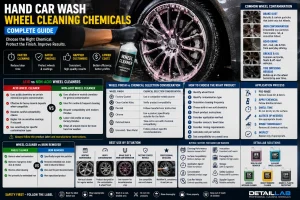
Because a hand car wash sees such a wide variety of wheel types in a single shift, many operations lean toward a more versatile, non-acid or pH-appropriate product for routine work and reserve specialized or more aggressive chemistry including acidic options for specific cases where it’s clearly appropriate. This is closely related to the buying considerations covered in DetailLab’s guide on hand car wash wheel cleaning chemicals, which goes deeper into selecting and managing wheel cleaning chemical inventory for high-volume operations.
Is Acid Wheel Cleaner Always Stronger?
No. Cleaning performance depends on far more than whether a product is acidic. Chemistry, pH, concentration, surfactants, solvents, iron-reactive ingredients, contact time, mechanical agitation, and the specific type of contamination all play a role. A well-formulated non-acid product can deliver strong cleaning performance, particularly on brake dust and road grime, without relying on acidic chemistry at all.
Is Non-Acid Wheel Cleaner Always Safer?
No. “Non-acid” describes the absence of acid chemistry it doesn’t automatically describe how aggressive or gentle the overall product is. Some non-acid products are strongly alkaline and require the same level of care as an acidic formula.
Because of this, it’s worth evaluating a few things regardless of which category a product falls into: pH where it’s available, the surfaces the product is intended for, the manufacturer’s instructions, dilution requirements, contact time, and any safety requirements listed on the label.
Acid vs Non-Acid Wheel Cleaner: Decision Guide
Do you know the wheel finish?
- No → Choose a product specifically recommended for uncertain or sensitive finishes, or verify the finish before proceeding.
- Yes → Continue.
Is the contamination routine?
- Yes → Consider a suitable non-acid or pH-appropriate wheel cleaner.
- No → Continue.
Is there heavy mineral or difficult contamination?
- Yes → Consider a suitable specialized cleaner, including acid chemistry only where the product and wheel finish permit it.
- No → Continue.
Is the contamination primarily embedded iron?
- Yes → Consider an appropriate iron remover.
Always: check product instructions, confirm surface compatibility, and follow safety requirements no matter which path applies.
How to Compare Wheel Cleaning Chemicals Before Buying
- Wheel finish compatibility
- Contamination type
- Acid/non-acid chemistry
- pH information
- Product concentration
- Dilution requirements
- Contact/dwell time
- Application method
- Rinsing requirements
- Safety instructions
- Cost per vehicle
- Intended use
- Manufacturer reputation and support
DetailLab Product Integration
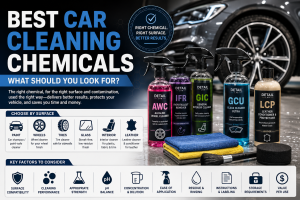
DetailLab’s cleaning chemicals lineup includes a couple of products relevant to this comparison. AWC Alkaline Wheel Cleaner is a non-acid, alkaline-based formula designed for factory-coated wheels and general wheel cleaning duty built to address brake dust, grease, and road grime as part of a routine or professional wash workflow. IFR Iron Fallout Remover is a reactive cleaner formulated specifically around iron contamination and brake dust, positioned as a decontamination step rather than an everyday wash-and-rinse product.
Neither product is presented here as a universal “best” option the right chemical still depends on your wheel finish, the contamination you’re dealing with, and the product’s own instructions. To see the full range of formulas, including current wheel cleaning options, visit DetailLab’s car cleaning chemicals collection.
Frequently Asked Questions
1. What is an acid wheel cleaner?
An acid wheel cleaner is a wheel cleaning chemical that uses acidic chemistry to react with mineral and metal-based deposits on a wheel’s surface.
2. What is a non-acid wheel cleaner?
A non-acid wheel cleaner is any wheel cleaning product that doesn’t rely on acidic chemistry this can range from pH-neutral formulas to strongly alkaline ones.
3. Is acid wheel cleaner better than non-acid?
Neither is universally better. The right choice depends on wheel finish, contamination type and severity, and the specific product’s instructions.
4. Is non-acid wheel cleaner safer?
Not automatically. Some non-acid products are strongly alkaline and require the same level of care as acidic ones.
5. What is the best wheel cleaner for brake dust?
It depends on the severity and type of brake dust. Routine dust often responds well to non-acid cleaners, while embedded iron may call for a dedicated iron remover.
6. Can acid wheel cleaner damage alloy wheels?
Yes, if the product isn’t matched to the specific alloy finish or is left on too long. Always confirm compatibility first.
7. Is acid wheel cleaner safe for factory-coated wheels?
It depends entirely on the specific product and the specific coating. Always check the manufacturer’s compatibility guidance.
8. Can I use non-acid wheel cleaner on chrome?
Many non-acid products are used on chrome, but strength and formulation still matter check the product label for chrome compatibility.
9. What is the difference between a wheel cleaner and an iron remover?
A wheel cleaner is a general-purpose product for wheel contamination, while an iron remover is formulated specifically around iron-reactive chemistry for embedded iron and rail dust.
10. When should I use an acid wheel cleaner?
When the product is designed for your wheel finish, contamination is genuinely difficult to remove with gentler options, and you can follow the safety and application instructions closely.
11. When should I use a non-acid wheel cleaner?
For routine maintenance, sensitive or uncertain finishes, and everyday brake dust and road grime.
12. Can wheel cleaning chemicals damage polished aluminum?
Yes, especially aggressive acidic products. Polished or bare aluminum generally needs extra caution.
13. Does pH matter when choosing a wheel cleaner?
Yes. pH gives a clearer picture of a product’s strength than the acid/non-acid label alone.
14. Can non-acid wheel cleaners be alkaline?
Yes. Many non-acid wheel cleaners use alkaline chemistry, which can range from mild to strong.
15. How do I choose the right wheel cleaning chemical?
Match the product to your wheel finish and contamination type, check the chemistry and pH where available, and follow the manufacturer’s instructions.
Conclusion
There’s no universal winner in the acid vs non-acid wheel cleaner debate. The better wheel cleaner depends on the wheel finish, contamination, product formulation, application method, and manufacturer’s instructions. For most routine maintenance, non-acid or pH-appropriate cleaners tend to be the practical choice, offering solid cleaning performance with a more forgiving margin across different wheel types. Acidic chemistry still has its place particularly for specific, difficult contamination but only when the product is genuinely suited to the wheel finish in question and used exactly as directed.
If you’re building out a wheel cleaning routine, whether for your own car or a professional detailing operation, explore DetailLab’s full car cleaning chemicals collection to find a formula that matches your specific wheels and contamination.


2 Responses