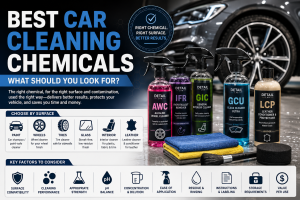

What is the best chemical for brake dust and iron contamination? The honest answer is that there isn’t one single “best” product for every car. The right choice depends on the type of contamination, the surface you’re cleaning (wheel or paint), the wheel finish, how severe the buildup is, and how the specific product is formulated. What most detailers agree on, though, is that a dedicated brake dust remover or iron remover for cars works better than plain soap and water, because bonded iron particles need targeted chemistry, not just scrubbing.
Brake dust looks like ordinary road grime, but it isn’t. A portion of it is made up of tiny metallic particles that can bond to a wheel or paint surface rather than simply sitting on top of it. That’s why an iron contamination remover exists as its own category of product it’s built to chemically react with iron, not just lift dirt. In this guide, we’ll walk through what brake dust and iron contamination actually are, why they’re hard to remove, how iron-reactive cleaners work, and what to look for in a wheel brake dust cleaner before looking at where a product like DetailLab IFR fits into the picture.
What Is Brake Dust?
Brake dust is the residue left behind when brake pads and rotors wear down during normal driving. Every time you brake, friction between the pad and rotor generates fine particles. Some of that debris is simply dust and grime. Some of it, depending on the composition of the brake pad and rotor, can be iron-rich.
Here’s why it builds up the way it does:
- Pad and rotor wear happens continuously, so wheels are exposed to fresh debris every time the vehicle is driven.
- Wheels sit closest to the source, so they naturally collect more brake residue than other exterior panels.
- High-temperature braking — hard stops, mountain driving, towing can bake particles onto the wheel surface, making them harder to rinse away later.
- Repeated exposure over days and weeks allows layers of residue to build on top of each other.
Not every vehicle produces the same kind of brake dust. Pad material, rotor type, and driving style all affect how much dust is created and how tightly it bonds to the surface. That’s part of why some wheels stay relatively clean with routine washing, while others develop stubborn, discolored buildup even with regular care.
What Is Iron Contamination?
Iron contamination refers to microscopic metallic particles that land on a vehicle’s surfaces and, in some cases, embed or bond into them. Brakes are one source, but they’re not the only one. Other common sources include:
- Rail dust, from vehicles parked or transported near railways
- Industrial fallout, airborne metal particles from factories or industrial areas
- Metallic road debris, kicked up from the road surface
- General environmental particles in areas with heavy vehicle or industrial traffic
Iron particles don’t only land on wheels. They can also settle on painted panels, lower body sections, and other exterior surfaces. Once there, some particles sit on the surface, while others can become embedded or chemically bonded which is why a regular wash, using shampoo and a wash mitt, may not fully remove them. If you run your hand over a washed panel and it feels slightly rough or gritty, that’s often a sign of contamination sitting below the surface film that a wash alone didn’t touch.
Brake Dust vs Iron Contamination
These two terms are closely related, but they aren’t identical. Here’s how they compare:
| Factor | Brake Dust | Iron Contamination |
| Main source | Brake components | Brake components + environmental sources |
| Common location | Wheels | Wheels + paint/exterior |
| Appearance | Dark/gray residue | Tiny embedded metallic particles |
| Removal difficulty | Can become baked on | Can become chemically bonded |
| Recommended approach | Wheel cleaning + targeted chemistry | Iron-reactive decontamination |
In short: all brake dust can contribute to iron contamination, but iron contamination can come from more than just brakes, and it can affect more than just your wheels.
Why Is Brake Dust So Difficult to Remove?
Brake dust often resists a normal wash for a few practical reasons.
Heat. Brakes generate significant heat during use, and that heat can help particles adhere more firmly to a wheel’s surface.
Bonding. Once particles make contact with a wheel, some can stick tightly rather than rinsing off with water alone.
Repeated exposure. Daily driving means daily contamination, so buildup can accumulate faster than it’s cleaned.
Neglected wheels. The longer contamination sits, the more difficult it tends to become to remove old deposits can harden and layer over time.
Mechanical scrubbing risk. It’s tempting to just scrub harder, but aggressive scrubbing can drag gritty, embedded particles across the wheel’s finish, increasing the risk of fine scratching rather than solving the problem.
This is exactly why targeted chemical cleaning matters. A product designed to react with the contamination itself can loosen deposits with far less physical force, reducing the reliance on hard scrubbing.
What Is an Iron Remover?
An iron remover is a specialized cleaning chemical formulated to chemically react with iron-containing contamination, rather than simply washing over the surface like a general shampoo.
Here’s generally what that involves:
- The product’s chemistry is designed to target and interact with iron particles specifically.
- As it reacts, it works to loosen contamination that has bonded to the surface.
- Many iron-reactive products produce a visible color change as they react with iron contamination though not every product behaves identically, and appearance can vary by formulation.
- After the reaction has had time to work, the surface is rinsed according to the product’s instructions.
- Iron removers are commonly used as part of a broader vehicle decontamination process, on wheels, paint, or both, depending on how the specific product is designed to be used.
How Do Iron-Reactive Cleaners Work?
At a high level, most iron-reactive cleaners follow a similar general process:
- The product is applied to the appropriate surface.
- The formula makes contact with iron contamination present on that surface.
- The reactive chemistry interacts with the iron particles.
- The contamination loosens or begins to break down.
- The surface is rinsed off according to the product’s instructions.
The exact chemistry behind any individual product is proprietary to its manufacturer, so we won’t speculate on specific ingredients, pH, or reaction mechanisms here. What matters for the end user is the concept: the goal is to chemically target iron contamination directly, rather than depending solely on mechanical scrubbing to remove it.
Brake Dust Remover vs Iron Remover
“Brake dust remover” and “iron remover” are often used somewhat interchangeably in product marketing, but they can describe different approaches depending on the specific product.
| Feature | Brake Dust / Wheel Cleaner | Iron Remover |
| Main purpose | Wheel cleaning | Iron decontamination |
| Road grime | Often yes | Not primary purpose |
| Brake dust | Depending on formulation | Yes, when iron-based |
| Embedded iron | Limited/depends on formulation | Specifically targeted |
| Paint use | Usually product-specific | Some products are designed for paint |
| Routine wheel cleaning | Common | More specialized |
| Decontamination | Secondary | Primary purpose |
Because these categories can overlap in how they’re marketed, the product’s actual instructions matter far more than its name on the label. Always check what surfaces a specific product is designed for before using it.
What Is the Best Chemical for Brake Dust?
As with the article’s opening question, there’s no single universal answer here either. The best brake dust remover for your situation depends on:
- The wheel’s finish (painted, clear-coated, bare alloy, chrome, and so on)
- How severe the contamination is
- Whether the dust is primarily surface-level or bonded/embedded
- The specific product’s formulation and intended use
- How often you clean your wheels
- The application method you’re comfortable using
For many vehicles, routine wheel cleaning with a standard wheel cleaner is enough to keep dust from building up. For wheels with heavier, bonded contamination, a dedicated decontamination step like an iron remover may be needed in addition to routine cleaning.
Best Chemical for Iron Contamination on Wheels
When comparing options for iron contamination specifically, here’s what’s worth looking at:
- Iron-reactive chemistry — is the product actually formulated to target iron, or is it a general-purpose cleaner?
- Clear usage instructions — dilution, application, and rinsing steps should be clearly labeled.
- Wheel compatibility — confirm the product is safe for your wheel’s specific finish.
- Application method — spray, foam, or dip, depending on your workflow.
- Contact time guidance — follow whatever the manufacturer recommends; don’t guess.
- Ease of rinsing — a product that rinses cleanly reduces workflow time.
- Professional usability — for shops, consistency across many vehicles matters.
- Cost per vehicle — an important factor for anyone using the product regularly.
It’s also worth remembering that an iron remover isn’t necessarily a replacement for a dedicated wheel cleaner. Many detailers use both: a wheel cleaner for routine grime, and an iron remover for embedded contamination.
Iron Remover for Cars: Can It Be Used on Paint?
Some iron removers are formulated specifically for use on painted surfaces, while others are designed with wheels or metal in mind. This varies by product, so it’s not something to assume.
Iron removers, when designed for paint, are commonly used on:
- Painted body panels
- Lower body panels (which tend to collect more road spray and debris)
- Wheels
- Other exterior metal surfaces
Never assume every iron remover is safe for every painted or coated surface. Always check the specific product’s label or manufacturer instructions to confirm which surfaces it’s designed for before applying it.
Paint decontamination matters because embedded contamination can interfere with later steps in the detailing process. Before claying, paint correction, waxing, sealing, or applying a ceramic coating, a clean, contamination-free surface generally gives better, longer-lasting results.
Iron Contamination and Paint Decontamination
Iron removal isn’t only a wheel-cleaning process it’s also a meaningful part of paint care. Signs of iron contamination on paint can include:
- Small orange or rust-colored specks scattered across panels
- A rough, gritty texture felt after an otherwise thorough wash
- Contamination linked to industrial fallout in certain areas
- Rail dust from vehicles parked or shipped near rail lines
- Generally embedded metallic particles that a wash alone doesn’t remove
When this kind of contamination is present, a chemical iron remover is typically used before any mechanical decontamination step (like claying), since it can loosen bonded particles without requiring as much physical abrasion. That said, not every vehicle needs routine iron removal it should be based on the contamination that’s actually present, not applied automatically at every wash.
When Should You Use an Iron Remover?
Some practical situations where an iron remover commonly comes into play:
When wheels have heavy brake dust that routine cleaning isn’t fully resolving.
When paint feels contaminated after washing — that gritty texture mentioned earlier.
Before paint correction, so contamination doesn’t interfere with polishing.
Before ceramic coating, since a clean surface supports better coating adhesion.
Before wax or sealant, for the same reason.
After exposure to industrial fallout, such as parking near a factory or construction site for an extended period.
When visible iron contamination appears, like rust-colored specks on the paint.
Iron removal isn’t necessarily something every vehicle needs at every wash it’s a targeted step used when contamination is actually present.
How to Choose an Iron Contamination Remover
A simple, practical buying framework:
- Identify the surface you need to clean (wheel, paint, or both).
- Identify the contamination — is it brake dust, rail dust, industrial fallout, or general grime?
- Confirm the product targets iron specifically, rather than being a general cleaner.
- Check compatible surfaces listed by the manufacturer.
- Review application instructions before purchasing, if available.
- Check recommended contact time guidance from the label.
- Check rinsing instructions to understand the full process.
- Consider product concentration, where applicable, for value and dilution flexibility.
- Consider cost per vehicle, especially for regular or professional use.
- Consider your workflow, particularly if you’re cleaning multiple vehicles a day.
Brake Dust and Iron Removal Process
While every product’s exact instructions differ, a general, safe workflow looks like this:
Step 1: Inspect the Surface. Identify the wheel finish (or paint condition) and assess the type and severity of contamination.
Step 2: Prepare the Vehicle. Follow the specific product’s preparation instructions, which may include rinsing the surface first.
Step 3: Apply the Iron Remover. Apply according to the manufacturer’s instructions don’t guess at dilution or coverage.
Step 4: Allow the Product to React. Give it the recommended contact time listed on the label.
Step 5: Observe the Reaction. Some products visibly change color as they react with iron this can help you see where contamination is present, though not all products behave the same way.
Step 6: Agitate if Required. Only use an appropriate, surface-safe tool if the product instructions specifically recommend agitation.
Step 7: Rinse Thoroughly. Follow the manufacturer’s rinsing guidance closely.
Step 8: Inspect. Check whether contamination remains, and assess whether a repeat treatment is needed.
Step 9: Repeat Only When Appropriate. Avoid unnecessary repeated chemical exposure on the same area.
Step 10: Continue the Detailing Process. Move on to further decontamination, polishing, or protection as needed.
We won’t provide specific dwell times or dilution ratios here, since these vary by product always defer to the manufacturer’s label.
Common Mistakes When Removing Brake Dust
Using only car shampoo. General shampoo is designed to lift surface dirt, not chemically break down bonded iron contamination.
Scrubbing too aggressively. Hard scrubbing can drag gritty, embedded particles across the surface, increasing the risk of fine scratches.
Using the wrong chemical. Not every cleaner is designed for every surface check compatibility first.
Assuming acid is always required. Iron contamination doesn’t automatically mean an acid-based wheel cleaner is necessary; many iron-reactive products aren’t acid-based at all.
Ignoring wheel finish. Painted, clear-coated, and bare alloy wheels can react differently to the same product.
Letting chemicals dry on the surface. Always follow manufacturer instructions, and avoid letting a product dry uncontrolled on a hot panel or wheel.
Ignoring safety instructions. PPE and proper handling matter see the safety section below.
Using wheel tools on paint. Brake dust and road grime can carry abrasive particles, so keeping wheel-specific tools separate from paint tools helps avoid cross-contamination and scratching.
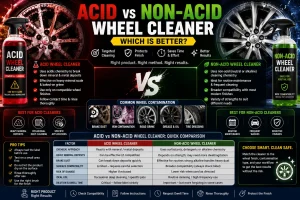
Iron Remover vs Acid Wheel Cleaner
These two categories are sometimes confused, but they aren’t interchangeable.
| Factor | Iron Remover | Acid Wheel Cleaner |
| Main target | Iron contamination | Certain heavy/mineral contamination |
| Paint use | Product-specific | Usually more limited/product-specific |
| Brake dust | Yes, when iron-based | Can address certain deposits |
| Wheel use | Common | Common but finish-dependent |
| Chemical approach | Iron-reactive | Acidic chemistry |
| Primary purpose | Decontamination | Wheel cleaning |
| Surface compatibility | Must be checked | Especially important |
For a deeper look at how these approaches compare, see our guide: Acid vs Non-Acid Wheel Cleaner: Which Is Better?
Iron Remover vs Wheel Cleaner
In a professional detailing workflow, these products often work together rather than replacing one another:
- Routine wheel cleaning → standard wheel cleaner
- Embedded iron contamination → iron remover
- Heavy or general road grime → the appropriate wheel-cleaning chemical for the job
- Paint decontamination → a paint-safe iron remover, where the specific product is designed for that use
One product isn’t automatically a substitute for the other they generally address different problems.
Brake Dust Removal for Professional Detailers
For professional and commercial use, a few additional factors come into play beyond what a home user might weigh:
- Consistent results across many vehicles
- Fast, repeatable workflow
- Surface compatibility across a wide range of wheel and paint finishes
- Product efficiency (how much product is needed per vehicle)
- Cost per vehicle
- Ease of rinsing at volume
- Clear instructions that support staff training
- Repeatable, predictable results
- Proper storage requirements
| Factor | Why It Matters |
| Cleaning performance | Helps remove stubborn contamination |
| Surface compatibility | Reduces risk of finish damage |
| Reaction time | Affects workflow |
| Cost per vehicle | Controls operating cost |
| Application | Improves consistency |
| Instructions | Supports staff training |
| Packaging | Important for high-volume work |
Best Iron Remover for Different Applications
Rather than ranking products from best to worst, it’s more useful to think in terms of the application:
Best for Wheel Decontamination
Look for iron-reactive products specifically designed and labeled for use on wheels.
Best for Paint Decontamination
Look for products explicitly stated by the manufacturer to be designed for painted vehicle surfaces.
Best for Professional Detailing
Prioritize consistency, surface compatibility, workflow speed, and cost per vehicle.
Best for DIY Detailers
Prioritize ease of use, clear instructions, confirmed surface compatibility, and whether the contamination genuinely warrants the treatment.
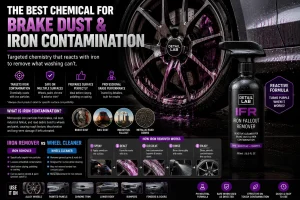
DetailLab IFR Iron Fallout Remover
DetailLab’s Cleaning Chemicals collection describes IFR simply as a “reactive cleaner for brake dust and iron contamination.” According to DetailLab’s own product page, IFR is a professional-grade decontamination product designed to remove embedded iron particles, brake dust, industrial fallout, rail dust, and other metallic contaminants from paintwork, wheels, and exterior surfaces, and is intended to help prepare surfaces for polishing, waxing, or ceramic coating.
Based on the applications listed on DetailLab’s product page, IFR is positioned for use on:
- Brake dust and iron contamination generally
- Alloy wheels and steel wheels
- Painted body panels, bumpers, fenders, doors, hoods, and trunks
- Chrome and painted exterior trim
- Lower body panels and other exterior surfaces
- Surface preparation ahead of claying, polishing, or coating
As with any decontamination product, we won’t speculate on IFR’s exact pH, dilution ratio, precise reaction time, or ingredient list details that aren’t published aren’t something to guess at. Always follow the instructions on the product label and any manufacturer guidance provided at the time of purchase.
Explore DetailLab IFR Iron Fallout Remover for targeted brake dust and iron contamination removal, and browse the full car cleaning chemicals range for complementary wheel and paint-care products.
How Iron Removal Fits Into a Complete Detailing Process
Iron decontamination is typically one step within a broader detailing sequence, rather than a standalone task:
- Initial wash — remove loose surface dirt.
- Wheel cleaning — address routine wheel grime and brake dust.
- Iron decontamination — chemically target embedded iron particles, where present.
- Mechanical decontamination (such as claying) — remove any remaining bonded contaminants.
- Paint correction — address swirl marks or surface imperfections, if needed.
- Protection — apply wax, sealant, or ceramic coating.
Iron removal tends to be most useful ahead of polishing or protective treatments specifically when contamination is actually present. Not every vehicle needs every step at every service the right sequence depends on the vehicle’s actual condition.
How Often Should You Use an Iron Remover?
There’s no single schedule that fits every vehicle. Frequency depends on:
- Driving environment (urban traffic, highway, rural)
- Type of brake system and pad material
- Overall vehicle usage and mileage
- Proximity to industrial areas or rail lines
- Whether contamination is visibly present
- Current surface condition
- Your personal or shop detailing routine
In general, iron decontamination is best performed when contamination is actually present whether that’s visible discoloration, a rough texture after washing, or heavy wheel buildup rather than treating it as an automatic step at every single wash.
Safety Considerations
Whenever using any brake dust remover or iron contamination remover, keep the following in mind:
- Always read the product label before use.
- Follow the manufacturer’s instructions exactly.
- Wear appropriate PPE, such as gloves and eye protection.
- Avoid eye and skin contact.
- Work in a well-ventilated, appropriate environment.
- Avoid applying the product to surfaces it isn’t designed for.
- Don’t let the chemical dry on the surface unless the label specifically says otherwise.
- Rinse thoroughly according to the product’s instructions.
- Never mix chemical products together.
- Store the product in its original, labeled container.
- Keep all cleaning chemicals away from children and pets.
Frequently Asked Questions
1. What is the best brake dust remover?
There isn’t a single universal answer it depends on your wheel finish, contamination severity, and the specific product’s formulation. Always match the product to your surface and follow its instructions.
2. What is an iron remover for cars?
It’s a specialized cleaning chemical formulated to chemically react with iron-based contamination on wheels and, in some cases, paint, helping loosen particles that ordinary washing won’t remove.
3. What is iron contamination on a car?
It’s microscopic metallic particles often from brakes, rail dust, or industrial fallout that land on and can bond to wheels or paint.
4. Does an iron remover remove brake dust?
Yes, when the brake dust involved is iron-based, since iron removers are specifically formulated to react with that type of contamination.
5. Is an iron remover safe for car paint?
Some are, and some aren’t it depends entirely on the specific product. Always check the manufacturer’s label to confirm which surfaces it’s designed for.
6. Can I use iron remover on alloy wheels?
Many iron removers are designed for alloy wheels, but compatibility depends on the specific product and wheel finish. Check the label first.
7. What is the difference between an iron remover and wheel cleaner?
A wheel cleaner is generally built for routine grime removal, while an iron remover is built specifically to target embedded iron contamination.
8. Is an iron remover better than an acid wheel cleaner?
They’re not directly interchangeable they target different types of contamination through different chemistry. The better choice depends on what’s actually on your wheels.
9. How does an iron-reactive cleaner work?
It’s applied to the surface, reacts chemically with iron particles, loosens the contamination, and is then rinsed away according to the product’s instructions.
10. How often should I use an iron remover?
There’s no universal schedule use it when contamination is actually visible or present, rather than at every routine wash.
11. Should I use an iron remover before clay?
Yes, iron decontamination is commonly performed before mechanical decontamination like claying, since it can loosen bonded particles chemically first.
12. Should I use an iron remover before ceramic coating?
Yes, when contamination is present. A clean, decontaminated surface generally supports better coating adhesion and performance.
13. Can brake dust damage wheels?
Over time, bonded brake dust left untreated combined with aggressive scrubbing to remove it can contribute to surface wear or finish damage.
14. Can iron contamination damage car paint?
Yes, embedded iron particles left untreated can contribute to oxidation, rough texture, and long-term finish issues if not addressed.
15. What should I look for in an iron contamination remover?
Confirmed iron-reactive chemistry, clear usage and safety instructions, verified surface compatibility, and a formulation suited to your specific application DIY or professional.
Conclusion
Brake dust and iron contamination aren’t the same as ordinary road dirt they’re often made up of metallic particles capable of bonding to wheels and, in some cases, paint. That’s why an iron-reactive cleaner exists as its own category: it’s designed to chemically target that contamination, rather than relying purely on scrubbing. A dedicated wheel cleaner and a dedicated iron remover can play different roles in a detailing routine, and the right product for you depends on your surface, your wheel finish, and how much contamination you’re actually dealing with. Iron removal tends to matter most before polishing or protective treatments, when contamination is present and whichever product you choose, always follow the manufacturer’s label and instructions closely.
If you’re looking for a reactive cleaner for brake dust and iron contamination, explore DetailLab’s Cleaning Chemicals collection, including DetailLab IFR Iron Fallout Remover, to find the right fit for your wheels, paint, and detailing workflow.