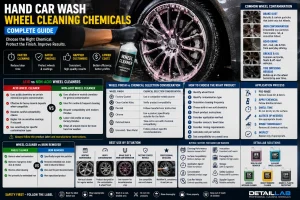

What is the best wheel cleaning chemical for a hand car wash? There isn’t a single answer. The right hand car wash wheel cleaning chemical acid or non-acid product depends on the wheel finish, the type and severity of contamination, the application method, and how often the wheel is washed. A chemical that suits a bare steel truck wheel can be the wrong choice for a factory-coated alloy wheel on a daily-driven sedan.
For a professional hand car wash, this is a business decision that affects labor time, cost per vehicle, customer satisfaction, and finish-damage risk. The strongest chemical on the shelf isn’t automatically the best one for your bay.
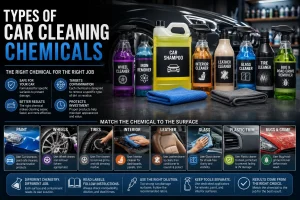
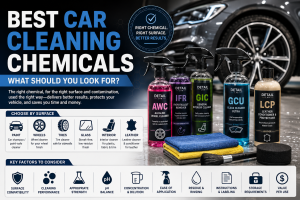
This guide covers what wheel cleaning chemicals are, why wheels need dedicated products, how acid and non-acid formulas differ, and how to build a buying process that fits your workflow.Learn more with our Car Cleaning Chemicals Guide to discover the different types of car cleaning chemicals, their uses, and how to choose the right products for exterior washing, wheels, tires, glass, and interior surfaces. This guide helps car owners and detailing professionals select suitable cleaning solutions for effective and safe vehicle care.
What Are Wheel Cleaning Chemicals?
Wheel cleaning chemicals are products formulated to break down the contamination that builds up on wheels and rims. Standard car shampoo is designed for painted panels and light surface dirt, and it typically isn’t strong enough to cut through the baked-on grime that collects on wheels, which sit closer to the road, tires, and brakes than any other part of the vehicle.
Wheels regularly collect brake dust, road grime, mud, grease, oil residue, tire dressing residue, iron particles, and general environmental contamination like soot, pollen, and salt. Because this is often baked on by heat from braking and driving, wheel cleaning chemicals are formulated to loosen and dissolve it with less scrubbing different formulas target different contamination types and surfaces, so “wheel cleaner” isn’t one interchangeable category.
Why Do Hand Car Washes Need Dedicated Wheel Cleaning Chemicals?
For a professional hand car wash, dedicated wheel cleaning chemicals aren’t a luxury they affect how the business runs. A product built for wheel contamination can improve cleaning efficiency, reduce manual scrubbing, handle brake dust and grime more consistently, improve consistency across staff and shifts, speed up workflow, and reduce unnecessary agitation that wears down brushes and finishes over time.
The right product depends on the wheels you clean most and the contamination you typically see a shop servicing daily commuters has different needs than one servicing trucks, fleets, or off-road vehicles.
| Requirement | Why It Matters |
| Cleaning performance | Removes contamination efficiently |
| Surface compatibility | Helps avoid finish damage |
| Application time | Improves workflow |
| Dilution instructions | Ensures consistent use |
| Rinsing | Helps remove chemical residue |
| Cost per vehicle | Helps control operating costs |
Common Types of Wheel Contamination
Brake dust forms as pads and rotors wear during driving — fine metallic and carbon particles that bond to a hot wheel and can be hard to remove with plain water once left too long.
Iron contamination comes from brake dust, rail travel, and industrial or airborne fallout. Particles embed into wheels or paint and are often invisible individually; because standard cleaners aren’t always designed to react with iron, some detailers use a separate iron-removing product.
Road grime is the general buildup of dirt, mud, oils, and film from everyday driving usually less aggressive than brake dust but still needing a dedicated cleaner once dried and hardened.
Grease and oily contamination shows up most on trucks, fleet, and off-road vehicles, and often needs stronger degreasing chemistry than light dust.
Tire dressing and product residue builds up around the wheel barrel and lip over time a maintenance issue rather than heavy contamination, but it still affects how clean a wheel looks.
Not every one of these contaminants requires an acid wheel cleaner. A well-formulated non-acid cleaner, combined with proper dwell time and light agitation, is often enough.
Acid vs Non-Acid Wheel Cleaners
This is the core decision most hand car washes and detailers face.
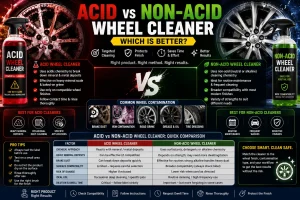
An acid wheel cleaner uses acidic chemistry to help break down certain mineral and inorganic contamination. It can be effective in specific applications, but wheel-finish compatibility is critical not every coating or metal surface is designed for acidic cleaning, so acid cleaners are generally used with more caution.
A non-acid wheel cleaner, often alkaline or neutral-pH, is commonly used for routine maintenance and suits a wide range of modern finishes, including factory-coated and clear-coated alloy wheels. Its main limitation is that heavy or long-neglected contamination may need more dwell time or agitation than an acidic product would.
| Factor | Acid Wheel Cleaner | Non-Acid Wheel Cleaner |
| Cleaning approach | Uses acidic chemistry on certain mineral/inorganic contamination | Uses alkaline or neutral chemistry for general contamination |
| Heavy contamination | Can be effective when the product and wheel are matched correctly | May need more dwell time or agitation on very heavy buildup |
| Routine maintenance | Not typically needed for light, regular cleaning | Well suited to frequent, routine wheel washing |
| Surface compatibility | Requires careful compatibility checks | Generally broader compatibility, but always verify |
| Wheel finish considerations | Higher risk on sensitive coatings if misused | Lower risk profile on many factory finishes |
| Application requirements | Follow label instructions and contact time closely | Follow label instructions; more forgiving of minor timing variance |
| Professional use | Used selectively for specific contamination types | Common as a primary, everyday wheel cleaner |
| Safety considerations | Requires attentive handling and rinsing | Still requires proper handling and rinsing |
There’s no universal winner. The right choice depends on wheel finish, contamination, product formulation, and manufacturer’s instructions.
When Should a Hand Car Wash Use an Acid Wheel Cleaner?
An acidic wheel cleaner may be worth considering for mineral-based contamination a non-acid product struggles with, heavy deposits on a confirmed-compatible wheel, or an application the product is specifically formulated for. Even then: verify compatibility first, follow the label exactly, never assume tolerance, don’t reach for acid just because contamination looks heavy, respect contact time, and rinse thoroughly. This guide won’t provide specific concentrations or mixing instructions always follow the manufacturer’s label.
When Should You Choose a Non-Acid Wheel Cleaner?
A non-acid wheel cleaner is often the more practical default for routine maintenance, high-frequency washing, modern factory-coated and clear-coated alloy wheels, and businesses that want one versatile product for most cleaning. Non-acid doesn’t mean weak. Performance depends on the formulation, contamination level, application method, agitation, and dwell time before rinsing.
Factory-Coated and Clear-Coated Wheels
Modern wheels come in several finish types: factory-coated, clear-coated alloy, painted, chrome, polished metal, and uncoated metal and each affects how carefully a wheel cleaning chemical needs to be chosen.
| Wheel Finish | Chemical Selection Consideration |
| Factory-coated | Use a compatible wheel cleaner |
| Clear-coated | Verify product compatibility |
| Painted | Follow manufacturer instructions |
| Chrome | Use a product specifically suitable for the finish |
| Polished metal | Take extra care with chemical compatibility |
| Uncoated metal | Follow product-specific recommendations |
No wheel cleaning chemical acidic or non-acidic should be treated as universally safe for every finish. Always check manufacturer instructions for both the wheel and the product before applying anything new.
How to Choose the Right Wheel Cleaning Chemical
Use this step-by-step framework:
- Identify the wheel finish — factory-coated, clear-coated, painted, chrome, polished, or bare metal.
- Identify the contamination — brake dust, iron particles, road grime, grease, or residue.
- Determine cleaning frequency — daily washing needs a different profile than occasional deep cleaning.
- Choose acid or non-acid chemistry based on compatibility and severity, not which seems strongest.
- Check product instructions for compatible surfaces, dilution, contact time, and rinsing.
- Consider application method — spray bottle, foam applicator, pressure sprayer, or automated system.
- Consider contact/dwell time and match it to your workflow.
- Consider rinsing requirements, since some products need more thorough rinsing.
- Calculate cost per vehicle from dilution, container size, and amount used.
- Test compatibility on a small, inconspicuous area before full use on an unfamiliar finish.
Wheel Cleaning Chemicals for Professional Hand Car Washes
Beyond cleaning performance, a hand car wash should evaluate cleaning efficiency, consistency across staff, surface compatibility, application speed, concentration and dilution needs, cost per vehicle, packaging size for high-volume use, storage, staff training, label safety instructions, and supplier support.
| Buying Factor | Why It Matters to a Hand Car Wash |
| Cleaning performance | Reduces manual effort |
| Cost per vehicle | Controls operating costs |
| Concentration | Can affect product usage |
| Application speed | Improves vehicle turnaround |
| Surface compatibility | Reduces risk of damage |
| Instructions | Helps staff use products consistently |
| Packaging | Important for high-volume operations |
Acid vs Non-Acid: Which Is Better for a Car Wash?
Neither is universally better. The right choice depends on wheel finish, contamination type and severity, cleaning frequency, product formulation, application process, and manufacturer instructions.
Quick decision guide:
- Heavy mineral-type contamination → an appropriate acidic product only if the wheel finish is confirmed to allow it.
- Routine maintenance → a suitable non-acid cleaner is usually more practical.
- Sensitive or uncertain finish → verify compatibility before choosing.
- Unknown wheel finish → don’t default to aggressive chemistry.
Brake Dust and Iron Contamination
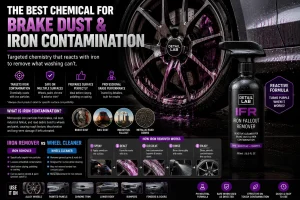
General wheel dirt, brake dust, and iron contamination aren’t the same thing, though they often show up together: general dirt is road film and light surface grime, brake dust is a byproduct of pad and rotor wear that bonds to a hot wheel, and iron contamination is embedded metallic particles from brakes, rail exposure, or industrial fallout that can affect both wheels and paint.
Because iron contamination behaves differently from general dirt, some detailers use a separate, iron-reactive cleaner rather than relying solely on a general wheel cleaner. DetailLab’s IFR Iron Fallout Remover is positioned by the manufacturer as a reactive cleaner for embedded iron particles, brake dust, and industrial fallout on both paint and wheels not as a universal wheel cleaner, but as a specific decontamination step alongside a general cleaner.
How to Apply Wheel Cleaning Chemicals Safely
- Read the product label before every use.
- Confirm the wheel surface is compatible.
- Work on cool wheels where instructed.
- Apply per the manufacturer’s directions.
- Respect the recommended contact/dwell time.
- Agitate with an appropriate brush only when called for.
- Rinse thoroughly with clean water.
- Inspect the wheel for remaining contamination.
- Repeat only if appropriate for that product.
- Store the chemical properly, per the label.
Never mix wheel cleaning chemicals together, and never extend contact time beyond the label’s recommendation. If you’re unsure a product suits a wheel finish, check with the manufacturer rather than guessing.
Common Wheel Cleaning Chemical Mistakes
- Using acid on an incompatible finish — confirm compatibility first.
- Using the strongest cleaner “just in case” — match the product to actual contamination.
- Ignoring product instructions — keep the label accessible at the bay.
- Applying chemicals to hot wheels — let wheels cool first.
- Letting chemicals dry on the surface — work in sections and rinse promptly.
- Using the wrong brush — match stiffness to the finish.
- Using one product for every wheel type — stock a general cleaner plus a specialized one.
- Not rinsing thoroughly — clear residue from barrels and lug nuts.
- Ignoring dilution instructions — measure consistently.
- Choosing products only by price — weigh cost per vehicle against performance.
Wheel Cleaner vs Iron Remover
| Feature | Wheel Cleaner | Iron Remover |
| Main purpose | General wheel contamination | Iron contamination |
| Brake dust | Depending on formulation | Specifically targets iron contamination |
| Road grime | Yes, depending on product | Not its primary purpose |
| Paint decontamination | Usually not primary use | Can be relevant for iron contamination |
| Routine wheel cleaning | Common | More specialized |
These two product types work together rather than replace one another.
Best Wheel Cleaning Chemical for Different Situations
Routine hand car wash maintenance: a suitable non-acid maintenance cleaner that fits your typical daily contamination level and applies quickly at high vehicle volume.
Heavy wheel contamination: a product designed for the specific contamination and wheel finish, not the strongest option by default.
Brake dust and iron contamination: iron-reactive chemistry, used per the label, as a decontamination step rather than a routine wash step.
Factory-coated wheels: compatibility above all else. DetailLab’s AWC Alkaline Wheel Cleaner is positioned by the manufacturer as a non-acid, alkaline-based cleaner intended for factory-coated wheels, along with steel, painted alloy, and chrome finishes, when used at the recommended dilution one option worth considering for shops that mainly service factory-finished wheels, not automatically the right fit for every wheel type or contamination level.
Professional detailers: workflow fit, consistency across jobs, cost per use, and surface compatibility across the vehicles you typically service.
How to Calculate Wheel Cleaner Cost Per Vehicle
A simple way to think about wheel cleaning chemical cost is:
Cost per vehicle = Product cost used per vehicle
To work this out for your business, consider purchase price, container size, dilution ratio, amount used per vehicle, vehicles cleaned in a given period, labor time, and overall cleaning efficiency.
Actual numbers vary by business, product, and dilution use your own purchasing and usage data rather than assuming a fixed cost.
How DetailLab’s Wheel Cleaning Products Fit Into a Professional Workflow
DetailLab’s Cleaning Chemicals range includes several products relevant to wheel care. AWC Alkaline Wheel Cleaner is positioned for general wheel contamination on factory-coated and other common finishes, while IFR Iron Fallout Remover addresses embedded iron and brake dust on wheels and paint. GIC General Interior Cleaner, IRC Insect Remover Cleaner, and EPP Engine & Plastic Protectant round out the range for interior, insect/road grime, and engine bay needs respectively. Each is designed for a specific role — match the chemical to the job.
Hand Car Wash Wheel Cleaning Chemical Buying Checklist
☐ Identify wheel finish ☐ Identify contamination type ☐ Decide routine vs heavy-duty cleaning ☐ Check acid/non-acid formulation ☐ Verify compatibility ☐ Read dilution instructions ☐ Check application method ☐ Check contact/dwell instructions ☐ Consider rinsing requirements ☐ Calculate cost per vehicle ☐ Consider staff workflow ☐ Check storage requirements ☐ Follow safety instructions
Frequently Asked Questions
1. What chemicals are used to clean car wheels?
Acid or non-acid (alkaline/neutral-pH) formulas, plus specialized iron-reactive cleaners for brake dust and iron contamination.
2. What is the best wheel cleaning chemical for a hand car wash?
There’s no single best product it depends on wheel finish, contamination level, application method, and washing frequency.
3. Are acid wheel cleaners better than non-acid wheel cleaners?
Neither is universally better. Acid suits certain contamination on compatible finishes; non-acid is often more practical for routine maintenance.
4. When should you use an acid wheel cleaner?
Only when the wheel finish is confirmed compatible and the contamination genuinely calls for it never by default.
5. Are acid wheel cleaners safe for factory-coated wheels?
Not always factory coatings vary, so verify compatibility with the label first.
6. What chemical removes brake dust from wheels?
General wheel cleaners handle surface-level dust; embedded or iron-based dust often needs an iron-reactive cleaner.
7. What is the difference between a wheel cleaner and an iron remover?
A wheel cleaner targets general contamination; an iron remover specifically targets embedded iron particles.
8. Can wheel cleaning chemicals damage alloy wheels?
Yes, if an incompatible product is used or instructions aren’t followed.
9. How do I choose a wheel cleaner for clear-coated wheels?
Pick a product stated as compatible with clear coats, and test a small area first.
10. How often should a hand car wash clean wheels?
Most clean wheels at every wash, using a routine maintenance product.
11. How can a car wash reduce wheel cleaning chemical costs?
Calculate cost per vehicle from dilution and usage, and match product strength to actual contamination.
12. What should I check before buying professional wheel cleaning chemicals?
Compatibility, contamination type, dilution/application instructions, safety guidance, packaging, and cost per vehicle.
Conclusion
Wheel contamination varies from vehicle to vehicle, and different finishes call for different chemical considerations. Acidic cleaners have useful applications but aren’t universally appropriate; non-acid cleaners are often practical for routine maintenance; brake dust and iron contamination may call for specialized chemistry. Weigh cleaning performance, surface compatibility, cost per vehicle, application time, and safety together, and always follow the manufacturer’s instructions.
Explore DetailLab’s Cleaning Chemicals collection to find automotive cleaning solutions for different wheel and vehicle-cleaning applications.