
Introduction
What makes a car cleaning chemical the best choice? It’s not the strongest formula on the shelf, the cheapest bottle you can find, or the most expensive one either. The best car cleaning chemicals are the ones that match the job in front of you the surface, the contamination, and how you plan to apply the product.
That’s a more useful way to shop than chasing a single “best” label, because no single automotive cleaner performs equally well on paint, wheels, glass, leather, and fabric. A wheel cleaner built for brake dust isn’t designed for interior fabric. A glass cleaner isn’t formulated to strip tire grime. Choosing well means understanding a few key factors:
- The surface you’re cleaning
- The type of contamination you’re removing
- The chemical’s formulation and pH
- Concentration and dilution
- How the product is meant to be applied
- Safety requirements and storage
- What you’re actually trying to accomplish
DetailLab offers a range of automotive cleaning products built around these different vehicle-cleaning applications. Before getting into specific products, it helps to understand the criteria that separate a genuinely good car cleaning chemical from one that just looks good on a shelf.
For a broader overview of the different categories of automotive cleaning chemicals, see DetailLab’s complete guide to car cleaning chemicals.
What Makes the Best Car Cleaning Chemicals?
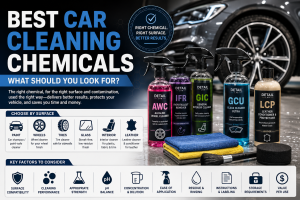
Not every car cleaning product is built the same way, and a handful of practical criteria explain why. Use this list as a mental checklist any time you’re comparing automotive cleaners.
- Surface Compatibility — The product should be formulated for the surface it’s marketed for, whether that’s clear-coated paint, coated wheels, glass, leather, or fabric.
- Cleaning Performance — It should actually lift the type of dirt or contamination it’s designed to remove, without excessive scrubbing.
- Appropriate Chemical Strength — Strength should match the job. A cleaner that’s too aggressive for the surface can cause more problems than it solves.
- pH — Acidic, neutral, and alkaline formulas behave differently on different materials, which affects both safety and results.
- Concentration and Dilution — Some products are ready-to-use; others are concentrates meant to be diluted. Knowing which you’re buying changes how much you actually get per use.
- Ease of Application — Spray, foam, or bucket-based products fit different workflows and skill levels.
- Residue and Rinsing — A good chemical should rinse cleanly or evaporate without leaving streaks, films, or buildup.
- Instructions and Labeling — Clear dilution ratios, contact times, and surface guidance are signs of a well-documented product.
- Storage Requirements — Some concentrates need to be stored a certain way to remain stable and effective.
- Value per Use — The real cost of a product depends on how much diluted solution it produces, not just the price on the bottle.
Choose Car Cleaning Chemicals Based on the Surface
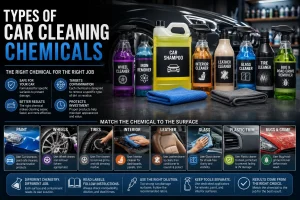
One of the most common mistakes buyers make is assuming a single all-purpose cleaner belongs everywhere on the vehicle. Different surfaces have different tolerances for pH, solvents, and mechanical agitation, so matching chemical type to surface is the first real decision in choosing car cleaning products.
| Vehicle Surface | Chemical Type | What to Look For |
| Paint | Car shampoo / paint-safe cleaner | Surface-safe formulation that won’t strip wax or sealant |
| Wheels | Wheel cleaner | Compatibility with the wheel’s factory finish or coating |
| Tires | Tire cleaner | Effective removal of tire grime without staining sidewalls |
| Glass | Automotive glass cleaner | Low-residue, streak-free finish |
| Leather | Leather cleaner | Formulated for leather without drying it out |
| Fabric | Fabric cleaner | Material-safe formulation for carpets and upholstery |
| Plastic | Interior/plastic cleaner | Suitable for interior trim without leaving a greasy finish |
| Exterior trim | Exterior cleaner/protectant | Compatible with plastic, rubber, or vinyl trim |
A cleaner formulated for wheels, for example, may use a pH profile that’s too aggressive for interior leather or fabric. Meanwhile, a mild interior cleaner won’t have the cleaning power needed to cut through baked-on brake dust. Reading the intended surface on the label and choosing accordingly prevents both wasted product and potential surface damage.
Choose Chemicals Based on the Type of Contamination
Surface is only half the equation. The type of contamination you’re dealing with also narrows down what chemical will actually work.
Dust and Light Dirt
Routine dust and road film are usually handled by a standard car shampoo during a normal wash. This is general maintenance cleaning, not decontamination.
Grease and Oils
Greasy residue, often found in engine bays or on lower body panels, may call for a stronger degreasing chemistry, depending on what the surface can tolerate.
Brake Dust
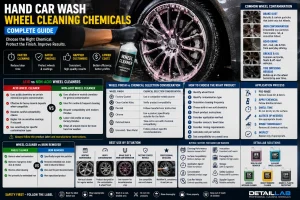
Brake dust builds up quickly on wheels and can be abrasive if simply wiped away. Dedicated wheel cleaners are formulated to loosen this type of grime before agitation.
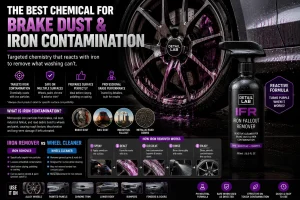
Iron Contamination
Iron particles embedded in paint or wheels are different from surface dust they’re bonded contaminants. Iron removers use a reactive chemistry that changes color as it works, which is a useful visual cue that it’s breaking down the contamination.
Insect Residue
Bug residue is often acidic and can etch paint if left too long. Dedicated insect removers are formulated to soften this residue for easier removal.
Road Grime
Heavier road grime and tar-like buildup benefit from a pre-wash or exterior cleaner designed to loosen contamination before the main wash, reducing the need for aggressive scrubbing.
Interior Stains
Stains on carpet, fabric, or leather need cleaners formulated for those specific materials a general-purpose cleaner may not lift a stain, and the wrong one can set it.
Contamination → Chemical Type
| Contamination | Chemical Type |
| Dust / light dirt | Car shampoo |
| Grease and oils | Degreasing cleaner (surface-dependent) |
| Brake dust | Wheel cleaner |
| Bonded iron particles | Iron remover |
| Insect residue | Insect / bug remover |
| Road grime, tar | Pre-wash or exterior cleaner |
| Interior stains | Fabric, carpet, or leather-specific cleaner |
Does pH Matter When Choosing Car Cleaning Chemicals?
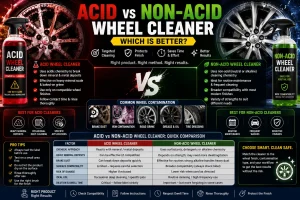
Yes, pH matters, but not in a “lower is stronger” or “higher is better” sense. In simple terms, pH describes how acidic, neutral, or alkaline a chemical is, and that chemistry affects how it interacts with different materials.
Acidic Cleaners
Acidic formulas can be effective on certain types of buildup, but they tend to be more surface-sensitive and require careful use.
Neutral Cleaners
Neutral-pH cleaners are generally considered gentler and are common for regular washing, since they’re formulated to minimize the risk of stripping wax, sealant, or coatings.
Alkaline Cleaners
Alkaline formulas are often used for cutting through grease and grime, and they’re common in dedicated wheel and degreasing products.
The key point is that no pH level is automatically “the best.” A product’s suitability depends on the surface it’s designed for, how it’s diluted, and how long it’s left in contact with that surface. Always follow the manufacturer’s instructions rather than assuming stronger chemistry always means better results.
Is a Stronger Car Cleaning Chemical Always Better?
No.
It’s tempting to assume the most powerful product will get the job done fastest, but strength and suitability are two different things. A chemical’s cleaning power needs to be balanced against:
- Surface safety — some surfaces simply can’t tolerate aggressive chemistry
- Concentration — a strong concentrate diluted correctly may be gentler in practice than a “mild” ready-to-use product used undiluted
- Contact time — how long a product sits on a surface changes how it performs
- Mechanical agitation — a brush or microfiber towel can reduce how much chemical strength is needed
- Application method — spray, foam, or soak-based methods change how a product needs to be formulated
For example:
- Routine paint washing rarely needs anything beyond a standard car shampoo.
- Wheel cleaning may call for a stronger, purpose-built wheel cleaner, but only one rated for the wheel’s specific finish.
- Interior cleaning usually benefits from a milder formula, since interior materials are more sensitive to harsh chemistry.
- Leather cleaning specifically requires a leather-safe cleaner, since general-purpose products can dry out or damage leather over time.
Choosing the strongest available product “just in case” is one of the more common and avoidable mistakes in automotive cleaning.
Why Chemical Concentration and Dilution Matter
Car cleaning chemicals generally come in two forms: ready-to-use products, which are applied straight from the bottle, and concentrated products, which are diluted with water before use.
Concentration affects a purchase in a few practical ways:
- Cost per use — a concentrate that dilutes to a large volume can offer more washes per bottle than it appears to at first glance.
- Consistency — following the manufacturer’s dilution ratio helps ensure the same result every time.
- Avoiding over-concentration — using a stronger-than-recommended mix doesn’t necessarily clean better and can increase the risk of surface issues or residue.
A concentrated product can be of excellent value when diluted correctly, but concentration by itself doesn’t prove a product is superior. Always follow the dilution instructions printed on the product rather than estimating.
How Application Method Affects Chemical Selection
The way a product is meant to be applied should factor into your buying decision, since a chemical formulated for one method may underperform with another.
Spray Application
Convenient for spot cleaning, interior surfaces, and glass usually ready-to-use.
Foam Application
Common for pre-wash and wheel products, where the foam helps the chemical cling to vertical or contoured surfaces for better contact time.
Bucket Application
Typical for car shampoos diluted into a wash bucket for full-vehicle washing.
Brush Agitation
Wheel and tire cleaners are often paired with a brush to help work the product into contoured or textured surfaces.
Microfiber Application
Interior, glass, and leather products are frequently applied and buffed with a microfiber towel for a clean, low-residue finish.
Rinse-Off Products
Some chemicals need to be rinsed after a set contact time; others are designed to be wiped away instead. Knowing which applies to your product matters for both results and surface safety.
Matching the product to how you actually plan to apply it rather than buying based on marketing alone helps ensure the chemical performs as intended.
Best Car Cleaning Chemicals by Use
Rather than ranking individual products, this section focuses on what to look for within each use case.
Best Chemicals for Exterior Washing
Look for a car shampoo that’s paint-safe and won’t strip existing wax or sealant. A pre-wash cleaner can help loosen road grime before the main wash. Insect residue and road-grime removers, such as DetailLab’s IRC Insect Remover Cleaner, are useful for spot-treating bonded contamination before it’s worked into the paint by a wash mitt.
Best Chemicals for Wheels and Tires
Wheel cleaners should be matched to the wheel’s finish — factory-coated wheels, for instance, may require a different formulation than uncoated or aftermarket finishes. DetailLab’s AWC Alkaline Wheel Cleaner is built for factory-coated wheels. For bonded brake dust and iron particles specifically, an iron remover like IFR Iron Fallout Remover targets that contamination through a reactive cleaning process rather than abrasive scrubbing. Tire cleaners are a separate category worth checking for sidewall-safe formulations.
Best Chemicals for Interior Detailing
Look for products designed specifically for interior materials plastic, fabric, carpet, and leather all behave differently. DetailLab’s GIC General Interior Cleaner is built for everyday cabin maintenance, while the DC Multi-Surface Detail Cleaner is useful for general stains across multiple interior materials. Leather needs its own dedicated products — DetailLab offers CLW Leather Wear Cleaner for worn or marked leather areas, LC Mid-Grade Leather Cleaner for regular seat cleaning, and LCP Leather Conditioner & Protectant for ongoing leather care after cleaning.
Best Chemicals for Glass
A good automotive glass cleaner should leave a streak-free, low-residue finish on both interior and exterior glass. DetailLab’s GCU Glass Cleaner Ultra is formulated to evaporate quickly, which helps reduce streaking during application.
Best Automotive Cleaning Chemicals for Beginners
Beginners don’t need every product on the shelf — they need the handful that cover the most common tasks.
Essential
- Car shampoo
- Wheel cleaner
- Tire cleaner
- Interior cleaner
- Glass cleaner
- Microfiber towels
Useful Additions
- Insect / bug remover
- Iron remover
- Multi-surface cleaner
- Leather cleaner (if the vehicle has leather seats)
Advanced
- Specialized decontamination products
- Paint correction chemicals
- Professional-grade protection products
The goal for a beginner isn’t to buy everything at once it’s to buy according to actual cleaning needs and expand the collection as those needs become clearer.
Best Car Cleaning Chemicals for Professional Detailers
Professionals evaluate car cleaning chemicals differently than a typical DIY buyer, because volume, consistency, and workflow speed carry more weight.
Professional detailers should weigh:
- Consistency — the product needs to perform the same way, wash after wash
- Cleaning performance — measured against real-world workflow, not just a single test
- Workflow efficiency — how quickly the chemical can be applied, dwelled, and rinsed
- Cost per use — concentrated products often make more financial sense at volume
- Dilution flexibility — being able to adjust strength for different jobs
- Surface versatility — fewer specialized products can simplify a professional kit
- Availability — reliable restocking matters for a business
- Packaging — bulk sizes reduce cost and packaging waste for high-volume use
- Storage — concentrates need appropriate storage conditions
- Technical information — clear labeling and safety data support consistent, safe use
| Factor | DIY User | Professional Detailer |
| Product quantity | Smaller, ready-to-use bottles | Larger volumes or concentrates |
| Concentration | Often ready-to-use | Frequently concentrated for dilution |
| Cost per use | Less of a priority | A key purchasing factor |
| Workflow speed | Less time-sensitive | Directly affects productivity |
| Product range | A handful of core items | Broader range for varied jobs |
| Surface specialization | General-purpose products | Surface-specific formulations |
| Storage | Minimal storage needs | Requires organized, appropriate storage |
How to Compare Car Cleaning Products Before Buying
Use this checklist any time you’re comparing two or more products:
- ☐ Identify the surface
- ☐ Identify the contamination
- ☐ Check intended use
- ☐ Check pH information where provided
- ☐ Check concentration/dilution
- ☐ Check application method
- ☐ Check surface compatibility
- ☐ Read manufacturer instructions
- ☐ Compare quantity
- ☐ Compare cost per use
- ☐ Check storage requirements
- ☐ Consider whether you actually need the product
How to Compare Price vs Value
The cheapest bottle on the shelf isn’t automatically the best value, and neither is the most expensive one. Value depends on a combination of factors:
- Product quantity — how much you actually get
- Concentration — a concentrate may go much further than its price suggests
- Dilution — the ratio determines how many washes a bottle produces
- Cost per use — the real metric for comparing two differently priced products
- Required tools — some products need specific applicators or equipment
- Cleaning efficiency — how much time and effort a product saves
- Frequency of use — how often you’ll realistically use the product
- Product versatility — whether it covers one task or several
Calculating cost per use rather than comparing sticker prices is the most reliable way to judge whether a product is genuinely good value.
Car Cleaning Chemicals You Should Not Choose by Price Alone
Buyers often default to one of a few shortcuts: picking the cheapest option, the most expensive one, the strongest-sounding formula, the most concentrated bottle, or whatever’s most heavily marketed. None of these shortcuts reliably identify the right product.
Formulation, intended use, surface compatibility, and how the product fits your actual workflow matter more than any single number on the label. A premium price doesn’t guarantee better surface safety, and a rock-bottom price doesn’t guarantee poor performance the fit between the product and the job is what actually determines value.
Common Mistakes When Buying Car Cleaning Chemicals
Buying one chemical for every surface — Use surface-specific products instead of relying on a single all-purpose cleaner for paint, wheels, glass, and interior alike.
Choosing the strongest product — Match chemical strength to the actual contamination and surface, not the label that sounds most powerful.
Ignoring surface compatibility — Always check that a product is rated for the surface you’re applying it to.
Ignoring dilution instructions — Follow the manufacturer’s dilution ratio rather than guessing.
Choosing only by price — Compare cost per use, not just the sticker price.
Buying too many products — Start with the essentials and expand only as specific needs come up.
Using household cleaners without checking compatibility — Household cleaning products aren’t formulated for automotive surfaces and can cause unexpected damage.
Ignoring manufacturer instructions — Contact time, dilution, and application method are all on the label for a reason.
Not considering your detailing routine — Buy for how often and how thoroughly you actually clean your vehicle, not for an idealized routine.
How to Build a Practical Car Cleaning Chemical Collection
Basic — For regular vehicle maintenance, covering the core wash-and-clean routine.
Intermediate — For enthusiasts who clean more frequently and want to address specific contamination types.
Professional — For detailers and commercial car wash businesses that need volume, consistency, and a wider surface-specific range.
| Chemical Category | Basic | Intermediate | Professional |
| Car shampoo | ✓ | ✓ | ✓ |
| Wheel cleaner | ✓ | ✓ | ✓ |
| Tire cleaner | ✓ | ✓ | ✓ |
| Interior cleaner | ✓ | ✓ | ✓ |
| Glass cleaner | ✓ | ✓ | ✓ |
| Iron remover | Optional | ✓ | ✓ |
| Insect/bug remover | Optional | ✓ | ✓ |
| Leather cleaner | As needed | ✓ | ✓ |
| Specialized chemicals | — | Optional | ✓ |
How DetailLab’s Cleaning Chemicals Fit Different Needs
DetailLab’s cleaning chemical range is organized around specific applications rather than a one-size-fits-all approach:
- Wheel cleaning — AWC Alkaline Wheel Cleaner is built for factory-coated wheels.
- Iron and brake dust removal — IFR Iron Fallout Remover is a reactive cleaner formulated for brake dust and bonded iron contamination.
- Interior cleaning — GIC General Interior Cleaner is designed for daily cabin maintenance.
- Multi-surface cleaning — DC Multi-Surface Detail Cleaner handles general stains across everyday detailing tasks.
- Leather care — CLW Leather Wear Cleaner targets worn and marked leather, LC Mid-Grade Leather Cleaner offers balanced regular leather cleaning, and LCP Leather Conditioner & Protectant nourishes leather with a matte finish after cleaning.
- Glass cleaning — GCU Glass Cleaner Ultra is a fast-evaporating formula built for clear visibility.
- Insect and road grime removal — IRC Insect Remover Cleaner is formulated for insect residue and road grime.
- Exterior plastic and engine bay care — EPP Engine & Plastic Protectant offers silicone-free protection for the engine bay and exterior plastic trim.
Each of these products addresses a specific surface or contamination type covered earlier in this guide the goal is choosing the one that fits your task, not defaulting to whichever product is most familiar.
Best Car Cleaning Chemicals: Quick Buyer Checklist
- ☐ Correct surface
- ☐ Correct contamination
- ☐ Suitable chemical type
- ☐ Appropriate pH
- ☐ Suitable concentration
- ☐ Clear dilution instructions
- ☐ Suitable application method
- ☐ Surface compatibility
- ☐ Safe storage
- ☐ Good cost per use
- ☐ Suitable for your experience level
- ☐ Suitable for your detailing routine
Frequently Asked Questions
1. What are the best car cleaning chemicals?
There’s no single “best” chemical the right one depends on the surface, the type of contamination, and how you plan to apply it. A good buying decision matches these factors rather than chasing one universal product.
2. What should I look for in car cleaning products?
Look at surface compatibility, cleaning performance, appropriate strength, pH, concentration, ease of application, residue, labeling clarity, storage requirements, and value per use.
3. What is the best chemical for cleaning car wheels?
A wheel cleaner rated for your wheel’s specific finish factory-coated, painted, or bare metal since not all wheel cleaners are compatible with every finish.
4. Are stronger car cleaning chemicals better?
No. A stronger chemical isn’t automatically better surface safety, concentration, contact time, and application method all affect whether a product is the right fit.
5. Does pH matter in automotive cleaning chemicals?
Yes. pH affects how a chemical interacts with different surfaces. Acidic, neutral, and alkaline formulas each have different strengths, and the right choice depends on the surface and task.
6. How do I choose a car cleaning chemical?
Start with the surface and the type of contamination, then check pH, concentration, and application method before comparing price and value.
7. What chemicals do professional car detailers use?
Professionals typically prioritize consistency, cost per use, dilution flexibility, and surface-specific formulations suited to a high-volume workflow.
8. What are the best car cleaning products for beginners?
A basic set covering car shampoo, wheel cleaner, tire cleaner, interior cleaner, glass cleaner, and microfiber towels covers most routine needs.
9. Should I buy concentrated or ready-to-use cleaners?
Both have a place. Concentrates can offer better value per use when diluted correctly, while ready-to-use products offer convenience for smaller or occasional jobs.
10. Can one car cleaning chemical be used on every surface?
Generally, no. Paint, wheels, glass, leather, and fabric each have different compatibility requirements, so surface-specific products typically perform better and reduce the risk of damage.
11. How do I compare different automotive cleaning chemicals?
Compare them on surface compatibility, contamination type, pH, concentration, application method, and cost per use rather than price alone.
12. Are expensive car cleaning products always better?
Not necessarily. Price doesn’t guarantee better surface safety or performance formulation and fit for your specific task matter more than cost.
Conclusion
There’s no universal “best” car cleaning chemical only the product that best matches your surface, your contamination, and how you plan to use it. Keep these buying principles in mind:
- Choose according to surface and contamination type, not marketing claims.
- Check pH and formulation where it’s relevant to the task.
- Always follow dilution instructions rather than guessing.
- Consider the application method the product is designed for.
- Compare cost per use rather than sticker price alone.
- Buy products that fit your actual detailing routine — not an idealized one.
Explore DetailLab’s Cleaning Chemicals collection to find automotive cleaning products suited to different vehicle-cleaning applications.