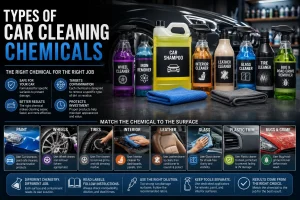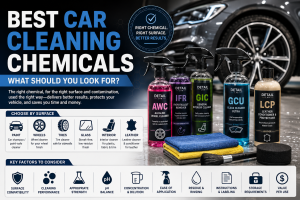

Modern vehicle care rarely relies on a single bottle. If you’ve ever wondered why a detailer’s trunk looks like a small chemistry lab, the answer comes down to one idea: different types of car cleaning chemicals exist because different vehicle surfaces and contaminants require different chemistry. Paint, wheels, tires, glass, leather, plastic, and fabric each react differently to dirt, and each reacts differently to cleaning agents too.
This guide breaks down the main categories of automotive cleaning chemicals, what each one is formulated to do, which surface it belongs on, and when it should be used. The goal isn’t to sell you every product on a shelf it’s to help you understand the classification system so you can match the right chemical to the right job.
Using the wrong product on the wrong surface isn’t just ineffective; it can leave residue, cause staining, dull a finish, or damage a protective coating. A wheel cleaner formulated for tough brake dust, for example, has no place on painted panels or interior leather. Understanding why categories exist is the first step toward avoiding those mistakes.
Below, we’ll walk through each major category of car cleaning products, show how they relate to one another, and explain how to build a chemical collection that actually matches your needs whether you’re washing your own car on weekends or running a professional detailing operation. This article is part of a broader resource on car cleaning chemicals and works alongside dedicated guides on topics like wheel cleaner chemistry and iron contamination, which are linked throughout.
What Are Car Cleaning Chemicals?
At their core, car cleaning chemicals are formulated liquids, gels, or sprays designed to loosen dirt, break down grease, and remove contamination from specific vehicle surfaces. Rather than being a single all-purpose category, automotive cleaning chemicals are engineered around the material they’re meant to touch paint. A clear coat behaves very differently from anodized wheel finishes, vinyl, or natural leather, so formulations vary accordingly.
It helps to separate the broader world of detailing chemicals into three functional groups:
- Car wash chemicals — products used during the routine exterior wash process, such as car shampoo, designed for regular dirt and road film removal without stripping wax or sealant.
- Detailing chemicals — more targeted cleaners and decontamination products used for specific contamination types, such as iron removers, wheel cleaners, or tar and bug removers.
- Protection products — items like plastic protectants or leather conditioners that aren’t primarily cleaners at all. Their job is to condition, protect, or finish a surface after it’s already clean.
This distinction matters because not every product in a detailer’s kit is a cleaner. Some clean. Others decontaminate. Some protect, some condition, and some exist purely to maintain an already-clean surface between washes. Knowing which job a product is doing helps prevent misuse using a protectant as if it were a cleaner, for instance, generally won’t remove dirt effectively, because that isn’t its purpose.
Main Types of Car Cleaning Chemicals
Before diving into each category individually, here’s a general overview of the main types of car cleaning chemicals, their primary purpose, and the surface they’re typically designed for.
| Chemical Type | Main Purpose | Common Surface |
| Car shampoo | Routine washing | Exterior paint |
| Wheel cleaner | Wheel contamination | Wheels |
| Tire cleaner | Tire grime | Tires |
| Iron remover | Iron contamination | Wheels / paint where specified |
| Interior cleaner | Interior dirt | Interior surfaces |
| Leather cleaner | Leather cleaning | Leather |
| Glass cleaner | Glass contamination | Windows |
| Multi-surface cleaner | General cleaning | Suitable surfaces |
| Bug remover | Insect residue | Exterior |
| Road-grime cleaner | Road film and grime | Exterior |
| Plastic cleaner/protectant | Clean and protect plastics | Interior/exterior trim |
| Paint cleaner | Surface cleaning | Automotive paint |
| Fabric/carpet cleaner | Textile cleaning | Seats/carpets |
Keep in mind that exact product capabilities vary by formulation and brand. Not every product within a category is automatically suitable for every surface it’s loosely associated with — always check individual product labeling before use.
1. Car Shampoo
Car shampoo is the foundation of routine exterior washing. It’s formulated to lift dirt and road film from paintwork while providing lubrication during the wash process, which helps reduce the friction that can cause fine scratches (often called swirl marks) as a wash mitt moves across the surface.
Most car shampoos are pH-balanced and paint-safe, meaning they’re designed to clean without stripping existing wax, sealant, or ceramic coating. This is a key reason household dish soap shouldn’t automatically be substituted for car shampoo dish soap is formulated to cut grease aggressively and can strip away protective layers along with the dirt, leaving paint more exposed than intended.
Compared to a dedicated wheel cleaner or iron remover, car shampoo isn’t a specialized decontamination product. It’s meant for the general layer of dust, pollen, and light road grime that accumulates during normal driving the starting point of an exterior wash rather than the tool for stubborn or specific contamination.
2. Wheel Cleaning Chemicals
Wheels accumulate some of the toughest contamination on a vehicle: brake dust, road grime, grease, and mineral deposits that bake onto the surface from heat generated during braking. Because of this, wheels generally need dedicated chemistry rather than the same shampoo used on paint.
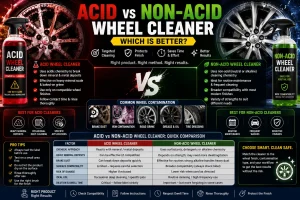
Wheel cleaners are broadly grouped into acid, non-acid, and alkaline formulations, each interacting differently with brake dust and wheel finishes. We won’t go deep into that comparison here — for a full breakdown of how these formulations differ and which situations call for each, see our dedicated guide, Acid vs Non-Acid Wheel Cleaner: Which Is Better?
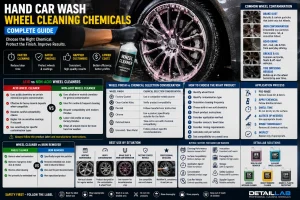
For businesses managing wheel cleaning at scale, our guide on Hand Car Wash Wheel Cleaning Chemicals: Complete Guide covers workflow and product selection in more depth.
One point worth emphasizing here: wheel finish compatibility is critical. Painted, powder-coated, chrome, and clear-coated wheels don’t all tolerate the same chemistry, so checking a product’s stated compatibility before application matters as much as choosing the right category.
DetailLab’s AWC is an alkaline wheel cleaner described as a fast, powerful wheel cleaner for factory-coated wheels, sitting within this category.
3. Tire Cleaning Chemicals
Tire cleaners and tire degreasers are formulated to remove road grime and, in many cases, strip old tire dressing residue before a fresh coat is applied. Rubber compounds hold onto grease and dirt differently than painted surfaces, which is why tires typically get their own dedicated chemical rather than sharing a shampoo or wheel cleaner.
It’s worth noting that tire chemicals often stronger degreasers by design shouldn’t automatically be used on painted body panels or other sensitive surfaces nearby. Overspray or careless application can affect trim, paint, or wheel finishes, so tire cleaning is usually treated as its own contained step in a wash routine.
4. Iron Removers
Iron removers target a very specific type of contamination: metallic fallout, most commonly brake dust and rail dust, that embeds into paint and wheel surfaces. These products typically work through a chemical reaction many change color (often turning purple or red) as they bond with and break down iron particles, making the decontamination process visible.
Not every iron remover is safe for every surface. Some are formulated specifically for wheels, while others are designed to be safe on painted exterior surfaces as well. This distinction matters, so always check what a specific iron remover is rated for before applying it broadly across a vehicle.
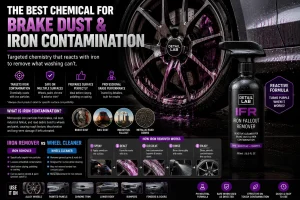
For a deeper look at iron contamination, how it forms, and how to remove it effectively, see Best Chemical for Brake Dust and Iron Contamination.
It’s also worth understanding the difference between an iron remover and a general wheel cleaner: a wheel cleaner is typically formulated for broad wheel grime, while an iron remover targets metallic particulate specifically the two can overlap in use but aren’t interchangeable by design.
DetailLab’s IFR is described as a reactive cleaner for brake dust and iron contamination, fitting squarely into this category.
5. Interior Cleaners
Interior cleaners are formulated for the cabin environment dashboards, door panels, vinyl trim, plastic surfaces, and the general dust, fingerprints, and light staining that accumulate from everyday use. Because interior surfaces include a mix of materials, choosing an interior cleaner suited to the specific material being cleaned matters more than reaching for a single generic spray.
For quick, everyday cabin maintenance, DetailLab’s GIC is described as a quick interior cleaner for daily cabin maintenance, positioning it as a general-purpose option for routine interior upkeep rather than deep-stain treatment.
6. Leather Cleaners
Leather cleaners are designed to lift dirt, body oils, and surface grime from leather upholstery without drying out or damaging the material. Leather maintenance is somewhat unique among interior surfaces because leather is a natural material that needs periodic conditioning in addition to cleaning.
It’s useful to differentiate between three related but distinct product types:
- Leather cleaner — removes dirt and grime from the surface.
- Leather conditioner — replenishes moisture and suppleness after cleaning.
- Leather protectant — helps guard against future wear, fading, or drying.
Leather surfaces can vary significantly between vehicles (finished, unfinished, aniline, pigmented, and so on), so checking product compatibility with your specific leather type is always worthwhile.
DetailLab offers a few products in this space: CLW is described as a leather surface cleaner for worn and marked areas, LC is described as a balanced leather cleaner for seats and interior leather, and LCP is described as leather nourishing care with a matte finish — positioning CLW and LC as cleaning-stage products and LCP as a conditioning/protectant-stage product.
7. Glass Cleaners
Automotive glass cleaners are formulated differently from general household glass cleaners because car glass deals with unique contamination — road film, fingerprints, haze from off-gassing plastics, and residue from the road. Both exterior and interior glass benefit from a dedicated cleaner.
Key traits of a good automotive glass cleaner include low residue, fast evaporation, and reduced streaking all of which matter for visibility and safety, not just appearance. Using a clean, dedicated microfiber towel also plays a big role in achieving a streak-free result, regardless of which cleaner is used.
DetailLab’s GCU is described as a fast-evaporating glass cleaner for clear visibility, aligning with these formulation priorities.
8. Multi-Surface Cleaners
Multi-surface cleaners are designed for convenience one product intended to handle general detailing and spot cleaning across a range of interior or exterior surfaces, depending on the specific formulation.
The trade-off is worth understanding clearly: convenience comes at the cost of some surface-specific specialization. A multi-surface label doesn’t mean a product is automatically safe for every surface it means the formulation has been designed with broader compatibility in mind. Always check a product’s stated intended applications rather than assuming universal use.
DetailLab’s DC is described as a multi-surface cleaner for stains and everyday detailing, fitting this category.
9. Bug Removers
Dried insect residue is notoriously difficult to remove once it’s baked onto a front bumper, mirror, or windshield by sun and heat. Bug removers are formulated to break down this residue, often as a pre-treatment step before mechanical washing, so it lifts away rather than requiring aggressive scrubbing that risks marring the paint.
DetailLab’s IRC is described as an effective insect and road grime cleaner, covering both this category and the related road-grime category below.
10. Road-Grime Cleaners
Road grime a mix of oil residue, dirt, mud, and general lower-panel contamination tends to concentrate on bumpers and lower body panels where a vehicle sits closest to the road surface. Because this grime often includes an oily component, it can benefit from chemical pre-treatment that loosens it before contact washing, reducing the need for heavy scrubbing.
As mentioned above, IRC serves this category as well, given its description as an insect and road grime cleaner.
11. Plastic Cleaners and Protectants
Plastic trim whether on the dashboard, door panels, exterior body cladding, or engine bay faces two separate challenges over time: dirt accumulation and UV-driven fading. This is why plastic products are generally split into two types:
- Plastic cleaner — removes dirt and buildup from the surface.
- Plastic protectant — helps maintain appearance and guard against fading going forward.
It’s worth being clear that protection products are not primarily cleaning chemicals. Their role kicks in after the surface is already clean.
DetailLab’s EPP is described as silicone-free protection for engine bay and exterior plastics, placing it in the protectant category for this type of trim.
12. Paint Cleaners
Paint cleaners occupy a specific place between routine washing and paint correction. Where car shampoo removes surface dirt, a paint cleaner is typically used for a deeper level of chemical decontamination addressing bonded contaminants that a wash alone won’t remove, often as preparation before polishing or coating.
It’s useful to understand how these related terms differ:
- Paint cleaner — chemically removes bonded surface contamination.
- Polish — uses mild abrasives to refine the paint’s clarity and remove light imperfections.
- Compound — a more aggressive abrasive product for correcting deeper defects like scratches or oxidation.
- Iron remover — chemically targets metallic fallout specifically, as covered above.
This article won’t turn into a full paint-correction guide — the goal here is simply to place paint cleaners correctly within the broader classification system.
13. Fabric and Carpet Cleaners
Fabric seats, carpets, and floor mats require different chemistry than leather or plastic because textile fibers absorb and hold onto stains and dirt differently. Fabric and carpet cleaners are formulated to lift ground-in dirt and treat stains within woven materials.
Since fabric cleaning sometimes involves extraction or rinsing steps depending on the product and the severity of the stain, it’s worth following the specific product’s instructions rather than assuming a one-step spray-and-wipe process will always be sufficient.
Car Cleaning Chemicals by Vehicle Surface
Here’s a practical reference for matching vehicle surfaces to the general chemical category they call for.
| Vehicle Surface | Recommended Chemical Category |
| Paint | Car shampoo / paint-safe cleaner / appropriate decontamination products |
| Wheels | Wheel cleaner / iron remover where appropriate |
| Tires | Tire cleaner |
| Dashboard | Interior cleaner |
| Leather seats | Leather cleaner |
| Fabric seats | Fabric cleaner |
| Carpet | Carpet/fabric cleaner |
| Glass | Glass cleaner |
| Plastic trim | Plastic/interior cleaner |
| Exterior plastic | Plastic cleaner/protectant |
| Bug-covered areas | Bug remover |
| Road-grime areas | Road-grime cleaner |
This is a general classification, not a strict rulebook. Product labels should always be checked, since formulations and intended uses vary between manufacturers.
Car Cleaning Chemicals by Type of Contamination
It’s often more useful to think from the contamination outward, rather than the surface inward. Here’s how common contamination types map to chemical categories.
| Contamination | Suitable Chemical Category |
| Dust | Car shampoo / interior cleaner depending on surface |
| Road grime | Road-grime cleaner |
| Brake dust | Wheel cleaner / iron remover depending on contamination |
| Iron particles | Iron remover |
| Tire residue | Tire cleaner |
| Insect residue | Bug remover |
| Grease/oil | Appropriate degreasing/detailing chemical |
| Fingerprints | Interior/glass cleaner |
| Leather dirt | Leather cleaner |
| Fabric stains | Fabric/carpet cleaner |
The practical takeaway: identify what the contamination actually is before reaching for a product. A cleaning failure is often less about product quality and more about a mismatch between the contamination present and the chemical chosen to address it.
Acidic, Neutral, and Alkaline Car Cleaning Chemicals
Automotive cleaning chemicals are often described by their pH — acidic, neutral, or alkaline — and it’s worth understanding this at a basic level, since it affects how a product interacts with different contamination and surfaces.
Acidic
Acidic formulations are often used for specific mineral or heavy contamination, where their chemistry helps break down deposits that neutral products may not fully address.
Neutral
Neutral formulations are often designed for gentler, more general cleaning, though this depends heavily on the specific formulation and concentration.
Alkaline
Alkaline formulations are often useful against grease, oils, and organic contamination, and are common in certain wheel-cleaning applications.
It’s important not to oversimplify these categories. “Acid” doesn’t automatically mean “strong,” “neutral” doesn’t automatically mean “weak,” and “alkaline” doesn’t automatically mean “safe.” Formulation, concentration, surface compatibility, and intended use all factor into how a product actually performs and how safely it can be used. For a full comparison specific to wheel cleaning, see Acid vs Non-Acid Wheel Cleaner: Which Is Better?
Car Cleaning Chemicals for Beginners
If you’re just starting to build a car care routine, you don’t need every category covered in this guide right away.
Essential:
- Car shampoo
- Wheel cleaner
- Tire cleaner
- Interior cleaner
- Glass cleaner
Useful additions:
- Iron remover
- Bug remover
- Multi-surface cleaner
- Leather cleaner
- Fabric/carpet cleaner
The best approach for beginners is buying based on actual cleaning needs — the surfaces and contamination you regularly deal with — rather than collecting every chemical category available.
Car Cleaning Chemicals for Professional Detailers
Professionals typically need a more complete and consistent chemical lineup: dedicated wheel chemistry, iron decontamination products, interior and leather cleaners, glass cleaner, fabric/carpet treatment, plastic protection, and bug/road-grime removers, selected according to the services actually offered.
Beyond product selection, professional operations also need to think about:
- Cost per use — how far a concentrate stretches once diluted
- Concentration and dilution — matching dilution ratios to the job at hand
- Workflow — sequencing chemicals logically through a wash or detail
- Surface compatibility — avoiding cross-contamination between wheel, paint, and interior products
- Product consistency — batch-to-batch reliability for repeat clients
- Storage — safe, organized storage for concentrates and diluted solutions
- Staff training — ensuring technicians understand which product goes where
Car Cleaning Chemicals for Hand Car Washes
A hand car wash operation benefits from organizing its chemical lineup around the actual wash workflow rather than treating chemicals as interchangeable:
- Pre-wash / snow foam
- Wheels
- Tires
- Exterior wash
- Interior
- Glass
- Specialized contamination (iron, bugs, road grime)
- Protection
Organizing by dedicated chemical category at each stage helps improve consistency across staff and reduces the risk of cross-contamination for example, wheel-cleaning brushes and chemicals staying separate from paint-safe wash tools. For a more detailed breakdown of wheel-specific workflow, see Hand Car Wash Wheel Cleaning Chemicals: Complete Guide.
DetailLab Cleaning Chemicals: Category Mapping
Here’s how DetailLab’s current cleaning chemical lineup maps to the categories covered in this guide, based on published product information.
| DetailLab Product | Category | Published Purpose |
| AWC | Wheel cleaner | Fast, powerful wheel cleaner for factory-coated wheels |
| CLW | Leather cleaner | Leather surface cleaner for worn and marked areas |
| DC | Multi-surface cleaner | Multi-surface cleaner for stains and everyday detailing |
| EPP | Plastic protection | Silicone-free protection for engine bay and exterior plastics |
| GCU | Glass cleaner | Fast-evaporating glass cleaner for clear visibility |
| GIC | Interior cleaner | Quick interior cleaner for daily cabin maintenance |
| IFR | Iron remover | Reactive cleaner for brake dust and iron contamination |
| IRC | Bug/road-grime cleaner | Effective insect and road grime cleaner |
| LC | Leather cleaner | Balanced leather cleaner for seats and interior leather |
| LCP | Leather care | Leather nourishing care with a matte finish |
How to Choose the Right Type of Car Cleaning Chemical
A simple decision framework can help narrow down the right product for any given task:
- What surface am I cleaning? Identifying the surface first is one of the safest ways to narrow down product selection.
- What type of contamination is present? Dust, grease, iron, insect residue, and grime all call for different chemistry.
- Do I need routine cleaning or specialized decontamination? A weekly wash and a deep decontamination pass aren’t the same task.
- Is the product specifically designed for that surface? Check compatibility rather than assuming.
- What does the manufacturer recommend for dilution and application? Following stated ratios and methods affects both safety and results.
- Do I need a cleaner, decontaminator, conditioner, or protectant? These serve different functions and often come in different products entirely.
Common Mistakes When Choosing Car Cleaning Chemicals
Using one chemical for everything. A single all-purpose spray can’t match the performance of surface-specific chemistry. Solution: build a small, targeted kit rather than relying on one bottle.
Choosing by strength alone. Stronger isn’t automatically better, and can risk surface damage. Solution: match the product to the contamination, not just its perceived strength.
Ignoring the surface. Applying a product without checking what it’s rated for is one of the most common causes of damage. Solution: always check the label before applying an unfamiliar product to a new surface.
Ignoring chemical pH. Acidic and alkaline products interact differently with different finishes. Solution: understand roughly where a product sits on the pH spectrum before using it on sensitive surfaces.
Ignoring dilution instructions. Overly concentrated solutions can increase the risk of streaking, residue, or surface issues. Solution: follow manufacturer dilution ratios rather than guessing.
Using wheel chemicals on paint. Wheel-specific formulations aren’t designed with paint clear coat in mind. Solution: keep wheel chemicals and applicators separate from those used on paint.
Using household cleaners without checking compatibility. General household products aren’t formulated for automotive surfaces. Solution: stick to automotive-specific formulations for automotive surfaces.
Confusing cleaner with protectant. Expecting a protectant to clean, or a cleaner to protect, leads to disappointing results. Solution: understand which job each product is actually built for.
Confusing iron remover with general wheel cleaner. These target different contamination and aren’t fully interchangeable. Solution: use iron remover specifically for metallic fallout, and wheel cleaner for broader wheel grime.
Buying products you don’t actually need. A shelf full of unused chemicals doesn’t improve results. Solution: start with the essentials and expand only as specific needs arise.
How to Build a Complete Car Cleaning Chemical Kit
Beginner Kit:
- Car shampoo
- Wheel cleaner
- Tire cleaner
- Interior cleaner
- Glass cleaner
Enthusiast Kit (adds to the beginner kit):
- Iron remover
- Bug remover
- Multi-surface cleaner
- Leather cleaner
- Fabric/carpet cleaner
Professional Kit: builds further with specialized products selected according to the specific services offered.
| Chemical Category | Beginner | Enthusiast | Professional |
| Car shampoo | ✓ | ✓ | ✓ |
| Wheel cleaner | ✓ | ✓ | ✓ |
| Tire cleaner | ✓ | ✓ | ✓ |
| Interior cleaner | ✓ | ✓ | ✓ |
| Glass cleaner | ✓ | ✓ | ✓ |
| Iron remover | Optional | ✓ | ✓ |
| Bug remover | Optional | ✓ | ✓ |
| Leather cleaner | Optional | ✓ | ✓ |
| Fabric/carpet cleaner | Optional | ✓ | ✓ |
| Plastic protection | Optional | ✓ | ✓ |
| Specialized chemicals | — | Optional | ✓ |
Frequently Asked Questions
What are the main types of car cleaning chemicals?
The main types of car cleaning chemicals include car shampoo, wheel cleaner, tire cleaner, iron remover, interior cleaner, leather cleaner, glass cleaner, multi-surface cleaner, bug remover, road-grime cleaner, plastic cleaner/protectant, paint cleaner, and fabric/carpet cleaner — each formulated for a specific surface or contamination type.
What chemicals are used for car detailing?
Detailing typically involves a mix of wash chemicals (like shampoo), targeted decontamination products (like iron remover and clay lubricant), and finishing products (like leather conditioner or plastic protectant), selected based on the vehicle’s specific condition.
What is the best chemical for cleaning car wheels?
Wheel cleaners come in acid, non-acid, and alkaline formulations, and the right choice depends on the wheel finish and contamination level. See our dedicated comparison for more detail.
What chemical removes brake dust?
Iron removers are formulated specifically to break down metallic brake dust particles, often through a visible color-changing chemical reaction.
What is an iron remover for cars?
An iron remover is a chemical decontamination product designed to bond with and break down iron particles such as brake dust or rail dust that have embedded into paint or wheel surfaces.
What type of chemical is used for car interiors?
Interior cleaners are formulated for dashboards, door panels, and general cabin surfaces, addressing everyday dust, fingerprints, and light dirt.
What is the difference between a leather cleaner and an interior cleaner?
A leather cleaner is formulated specifically for natural or synthetic leather upholstery, while a general interior cleaner is typically intended for broader cabin surfaces like plastic and vinyl trim.
What chemical is best for car glass?
Automotive glass cleaners are formulated for low residue and fast evaporation, which helps reduce streaking compared to general-purpose glass cleaners.
What is a multi-surface car cleaner?
A multi-surface cleaner is formulated for broader compatibility across several interior or exterior surfaces, offering convenience for everyday spot cleaning, though it isn’t automatically suitable for every surface.
What chemical removes bugs from a car?
A dedicated bug remover is formulated to break down dried insect residue, often used as a pre-treatment before the main wash.
What chemicals are used to clean tires?
Tire cleaners and degreasers are used to remove road grime and old dressing residue from tire rubber, preparing the surface for a fresh coat of dressing if desired.
What are professional car cleaning chemicals?
Professional car cleaning chemicals typically refer to a fuller lineup of dedicated products covering wheels, iron contamination, interior, leather, glass, fabric, and plastics selected for consistency, dilution flexibility, and workflow efficiency.
Can one car cleaning chemical be used on every surface?
Generally, no. While multi-surface cleaners offer broader compatibility, most automotive surfaces perform best with chemistry formulated specifically for that material and its typical contamination.
How do I choose the right automotive cleaning chemical?
Start by identifying the surface and the type of contamination present, then check whether a product is specifically rated for that surface and contamination before use.
Are car detailing chemicals different from car wash chemicals?
Yes. Car wash chemicals, like shampoo, are generally intended for routine exterior washing, while detailing chemicals are more targeted products used for specific contamination or finishing tasks.
Conclusion
Understanding the different types of car cleaning chemicals comes down to recognizing that surfaces and contaminants each call for their own chemistry. Wheel cleaners aren’t the same as iron removers. Leather cleaners aren’t the same as general interior cleaners. Cleaners and protectants serve entirely different purposes in a detailing routine. And critically, stronger chemistry isn’t automatically better — surface compatibility and correct application matter just as much as raw cleaning power.
Whether you’re just starting out with a basic wash kit or managing a full professional lineup, the same principle applies: identify the surface, identify the contamination, and choose chemistry built for that specific job. Always follow product instructions and verify surface compatibility before applying any new chemical.
Explore DetailLab’s Cleaning Chemicals collection to find the right automotive cleaning products for your detailing needs.