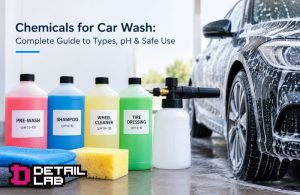

A car never gets clean because of water pressure alone. It gets clean because the right chemistry is applied to the right soil for the right amount of time. Road film, brake dust, insect protein, tree sap, and traffic fallout are all different problems. One bottle cannot solve all of them.
This guide explains the car cleaning chemicals used in a car wash from the first rinse to the final protection step. You will learn what each product does, why pH matters, how dilution changes results, and how to avoid the mistakes that damage paint and trim.
What Are Car Wash Chemicals?
Car wash chemicals are formulated cleaning solutions designed to lift soil from automotive surfaces without harming paint, glass, rubber, or plastic. They are not general household cleaners. A kitchen degreaser may strip wax and dull the clear coat.
Each product is built around a target soil type:
- Oily soils such as road film and exhaust residue
- Mineral soils such as brake dust and hard water deposits
- Organic soils such as bugs, sap, and bird droppings
- Static soils such as dust and pollen
Professional formulas also protect equipment. A wash tunnel or pressure washer exposed to the wrong chemistry corrodes quickly.
The Chemistry Behind a Clean Car
You do not need a chemistry degree to buy the right product. You do need to understand four building blocks.
Surfactants
Surfactants are the active cleaning molecules. One end of the molecule attracts water. The other end attracts oil. That dual behaviour lets the surfactant surround grease, lift it from the panel, and hold it in the rinse water so it does not settle again.
Four families appear in car care products:
- Anionic surfactants carry a negative charge. They foam well and handle oily road film. Most shampoos rely on them.
- Non-ionic surfactants carry no charge. They resist hard water, foam less, and excel at degreasing.
- Cationic surfactants carry a positive charge. They cling to surfaces and are used in drying agents and some protectants.
- Amphoteric surfactants shift charge with pH. They boost foam stability and reduce skin irritation.
pH
pH measures how acidic or alkaline a solution is on a scale of 0 to 14. Seven is neutral.
Alkaline chemistry breaks down oils and organic soil. Acidic chemistry dissolves minerals, iron, and water spots. This is the single most useful concept in the entire category.
| Product | Typical pH | Best at removing |
|---|---|---|
| Alkaline presoak | 11 to 13 | Road film, grease, bugs |
| Snow foam | 8 to 10 | Loose dirt and dust |
| Shampoo | 6 to 8 | General surface soil |
| Acidic presoak | 2 to 5 | Mineral film, water spots |
| Iron remover | 4 to 7 | Brake dust and rail dust |
| Acid wheel cleaner | 1 to 3 | Baked on brake dust |
Chelating Agents and Builders
Hard water contains calcium and magnesium ions. These ions bind to surfactants and stop them working. Chelating agents such as EDTA and citrate capture those ions so the surfactant stays active. They also help dissolve metal particles embedded in paint.
Builders such as sodium metasilicate raise alkalinity and improve soil suspension. They are common in heavy duty presoaks.
Solvents
Small amounts of glycol ether or d-limonene dissolve tar, adhesive, and heavy grease that water-based chemistry cannot reach. Solvent content is also why some products carry VOC limits in certain regions.
Chemicals for Car Wash, Stage by Stage
A professional wash follows an order. Each chemical prepares the surface for the next one.
1. Pre-Rinse
Plain water at moderate pressure removes loose grit. Skipping this step drags abrasive particles across the paint during the contact wash. This is where most swirl marks begin.
2. Presoak or Prewash
Presoak is the first chemical applied. It softens bonded soil so the wash step does less mechanical work.
- High pH presoak attacks grease, exhaust film, and insect residue. It is the standard choice for touchless and tunnel washes.
- Low pH presoak dissolves mineral film and neutralises alkaline residue. Touchless operations often run both in sequence for a two-step wash.
Dwell time matters more than concentration. Most presoaks need 30 to 90 seconds on a cool panel. Never let them dry.
3. Snow Foam
Snow foam is a thick, clinging foam applied through a foam cannon or foam lance. Its purpose is dwell, not scrubbing. The foam holds the cleaning solution against vertical panels long enough to release dirt before a mitt ever touches the car.
Good snow foam is pH neutral or mildly alkaline. It should be safe on wax, sealant, and ceramic coatings.
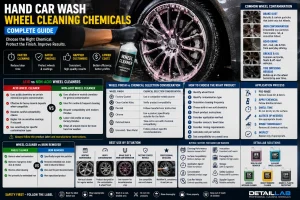
4. Wheel and Tire Cleaner
Wheels collect the harshest soil on any vehicle. Brake dust is hot metallic particulate that embeds itself into the finish.
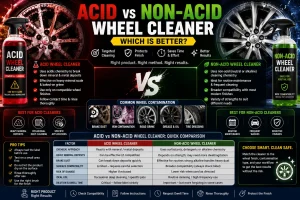
- Alkaline wheel cleaners handle oil, brake dust, and tire grime. They are safer on delicate finishes.
- Acidic wheel cleaners remove severe baked-on deposits quickly but demand caution. Many older formulas used hydrofluoric acid, which is extremely hazardous to skin and can etch clear coat, chrome, and polished aluminium. Modern responsible formulas avoid it.
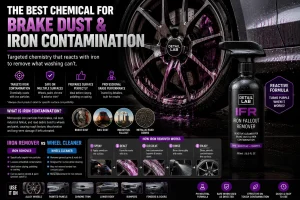
- pH-neutral iron removers contain a sulphur compound that reacts with ferrous particles and turns purple as it dissolves them. These are the safest option for coated or painted wheels.
Always test on a hidden area first. Never apply wheel cleaner to a hot rim.
5. Bug and Tar Remover
Insect remains are acidic proteins that etch clear coat within hours in summer heat. A dedicated bug remover softens the protein so it wipes away without scrubbing. Tar removers use solvents to dissolve asphalt and road adhesive from lower panels and wheel arches.
6. Car Shampoo
Shampoo is the heart of the wash. Its job is twofold. It cleans, and it lubricates so that a mitt or brush glides instead of grinding.
Choose a pH-neutral shampoo for maintenance washing on protected paint. Choose a stripping shampoo only when you intend to remove old wax before polishing or coating.
Use the two bucket method with grit guards. One bucket holds shampoo solution. The other holds clean rinse water for the mitt.
7. Rinse and Drying Agent
A drying agent, also called a rinse aid, changes the surface tension of water so it sheets off instead of beading into spots. Cationic polymers are common here. In commercial tunnels, this step cuts blower time and reduces water spot complaints.
Spot-free rinse systems use deionised or reverse osmosis water. Pure water leaves no mineral residue when it evaporates.
8. Protection
Protection is the final step and the one that decides how long the clean lasts.
- Carnauba wax gives a warm glow and lasts a few weeks.
- Polymer sealant gives sharper gloss and lasts several months.
- SiO2 ceramic spray bonds to the clear coat, adds strong water beading, and typically lasts six months or more.
- Spray wax and drying aid are applied during towel drying for quick top-up protection.
Detail Lab develops professional-grade cleaning chemicals and detailing tools for exactly this kind of staged workflow, with formulas built for both workshop volume and enthusiast use.
9. Tire Dressing and Trim Restorer
Tire dressings use silicone emulsions or water-based polymers to restore black rubber and block UV cracking. Water-based dressings give a satin finish and attract less dust. Solvent-based dressings give high gloss but can sling onto paint if over applied.
10. Interior Chemicals
The wash does not end at the door.
- All-purpose cleaner (APC) diluted between 1:10 and 1:20 handles dashboards, door cards, and door shuts.
- Upholstery and carpet cleaner uses enzymes and low-foam surfactants for extraction.
- Leather cleaner should be pH balanced near neutral to avoid drying the coating.
- Glass cleaner should be ammonia-free so it is safe on tinted film.
Additional Chemicals for Car Cleaning
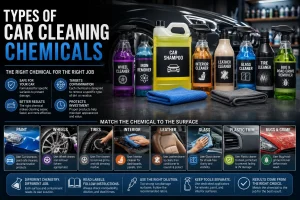
Beyond the basic wash stage, a complete detailing programme needs targeted formulas for wheels, glass, interiors, and leather. The range below covers those jobs.
| Chemical | Code | Specification | Best Used On | Link |
|---|---|---|---|---|
| Alkaline Wheel Cleaner | AWC | Concentrated alkaline formula. Low foam for fast rinsing. Dissolves brake dust, grease, oil, mud, and road film without aggressive scrubbing. Acid free alternative for hand wash and automated bays. | Steel, alloy, painted, chrome, and factory coated wheels | View AWC |
| Leather Wear Cleaner | CLW | Targeted cleaner for worn, scuffed, and heavily marked leather areas. Lifts body oils and transferred dye from high contact zones. | Bolsters, seat bases, steering wheels, armrests | View CLW |
| Multi Surface Detail Cleaner | DC | General purpose detailing cleaner for stains and routine soil. Works across mixed material surfaces in a single step. | Plastic, vinyl, painted trim, hard interior and exterior surfaces | View DC |
| Engine and Plastic Protectant | EPP | Silicone free protectant and dressing. Restores colour depth and shields plastics from heat and UV exposure. Leaves a non greasy finish. | Engine bay plastics, exterior black trim, covers and shrouds | View EPP |
| Glass Cleaner Ultra | GCU | Fast evaporating glass formula. Removes film, haze, and fingerprints with no streaking or residue. | Windscreens, side glass, mirrors, interior glass | View GCU |
| General Interior Cleaner | GIC | Quick action cabin cleaner for daily maintenance. Handles dust, light stains, and surface grime across mixed interior materials. | Dashboards, door cards, consoles, trim panels | View GIC |
| Iron Fallout Remover | IFR | Reactive decontamination fluid. Chemically dissolves embedded ferrous particles and changes colour as it works. Removes brake dust and rail dust without abrasion. | Paint, wheels, glass, coated and sealed surfaces | View IFR |
| Insect Remover Cleaner | IRC | Pre wash treatment that softens insect protein and bonded road grime. Prevents etching from acidic bug residue when removed promptly. | Front bumpers, grilles, mirrors, windscreens, leading edges | View IRC |
| Mid Grade Leather Cleaner | LC | Balanced strength leather cleaner for routine interior servicing. Cleans without stripping factory finish coatings. | Seats, door inserts, leather trim | View LC |
| Leather Conditioner and Protectant | LCP | Nourishing conditioner that restores suppleness and adds a protective layer. Dries to a matte factory look with no shine or slip. | Leather seats, steering wheels, gear surrounds, trim | View LCP |
Matching Chemicals to Your Wash Type
Different wash formats need different chemistry.
Touchless and in-bay automatic
No brushes touch the car, so chemistry does all the work. These systems need aggressive two-step presoaks, strong alkaline cleaners, and reliable drying agents.
Friction and soft cloth tunnel
Cloth provides mechanical action. Lubricity becomes the priority. Foaming detergents must protect paint from marring as the cloth passes over it.
Self-serve bay
Chemicals arrive through high-pressure spray. Foaming brush soap, presoak, tire cleaner, and wax are the standard menu.
Hand wash and detailing
The widest chemical range applies here. Dwell control is easy, so gentler products at correct dilution outperform harsh shortcuts.
Dilution Ratios That Actually Work
Concentrates save money, but only when measured. Guessing wastes product and risks damage.
| Product | Typical dilution | Notes |
|---|---|---|
| Snow foam | 1:10 to 1:20 in the cannon | Adjust for foam thickness |
| Car shampoo | 1:200 to 1:500 | Follow bucket volume, not eye level |
| APC (interior) | 1:10 to 1:20 | Stronger for door shuts |
| APC (engine bay) | 1:4 to 1:10 | Rinse thoroughly |
| Alkaline presoak | 1:20 to 1:50 | Never let it dry |
| Iron remover | Ready to use | No dilution needed |
Treat these as starting points. Water hardness, soil load, and temperature all shift the result. Test a small panel before committing.
Water Quality Changes Everything
Two workshops can use identical products and get different results. The variable is usually water.
Hard water with high TDS neutralises surfactants and leaves mineral spots after drying. Options include installing a water softener, using a deionised final rinse, or selecting formulas with stronger chelating packages. Drying the car quickly with a clean microfibre towel also prevents most spotting.
Safety and Storage Rules
Concentrated wash chemistry deserves respect.
- Wear nitrile gloves and eye protection when diluting concentrates.
- Add chemical to water, never water to chemical.
- Never mix products. Acid mixed with a chlorine-based cleaner releases toxic gas.
- Store acids and alkalis apart from each other.
- Keep containers labelled and sealed, away from direct sunlight.
- Ventilate enclosed bays when using solvent products.
- Follow local rules for wastewater discharge.
Common Mistakes to Avoid
- Washing in direct sunlight so products dry on the panel
- Using dish soap, which strips protection and dries rubber seals
- Applying wheel cleaner to hot wheels
- Skipping the pre-rinse and dragging grit across paint
- Using one bucket and reloading the mitt with dirt
- Leaving iron remover on longer than the label allows
- Buying strong chemistry instead of correct chemistry
A Simple Starter Chemical Kit
You can cover most vehicles with seven products.
- Alkaline prewash or snow foam
- pH-neutral car shampoo
- Iron remover or pH neutral wheel cleaner
- Bug and tar remover
- Glass cleaner
- Interior all-purpose cleaner
- Spray sealant or SiO2 protectant
Add tire dressing, clay lubricant, and leather cleaner as the routine grows.
Frequently Asked Questions
What chemicals are used in a car wash?
The core list includes presoak, snow foam, car shampoo, wheel and tire cleaner, iron remover, bug and tar remover, glass cleaner, drying agent, and a wax or sealant protectant.
Is alkaline or acidic better for washing a car?
Neither is universally better. Alkaline chemistry removes oily and organic soil. Acidic chemistry removes mineral and metallic soil. Serious operations use both at different stages.
Can I use dish soap to wash my car?
It is not advisable. Dish soap is engineered to strip fats. It removes wax and sealant and can dry out rubber and plastic trim over time.
How long should chemicals dwell on the paint?
Most presoaks and foams work within 30 to 90 seconds. The rule that matters is simple. Rinse before the product dries.
Are car wash chemicals safe for ceramic coatings?
Use pH-neutral shampoos and coating-safe maintenance products. Avoid high-alkaline strippers and strong acids on coated paint.
What causes water spots after washing?
Dissolved minerals left behind when water evaporates on the surface. A drying agent, a deionised rinse, or fast towel drying will prevent them.
Summary
Good results come from sequence and control, not from the strongest bottle on the shelf. Pre-rinse to remove grit. Pre-soak to soften bonded soil. Wash with lubricity. Treat wheels separately. Rinse properly. Protect at the end.
Learn what pH each product uses and what soil it targets. Once that clicks, choosing chemicals for car wash work stops being guesswork and becomes a repeatable process that protects the paint every single time.